When Climate Change Denialism Drives Federal Policy — A Recipe for Disasters
Mapping the Federal Retreat From Climate Action — Part 6
By Keith Nickolaus, PhD, CRBA Writers Team
This post is the sixth and final post in our ongoing series: Mapping the Federal Retreat From Climate Action.
Over the past several weeks in this six-part blog series, we’ve examined how federal cuts to climate science, environmental protection, and disaster preparedness could affect communities in the San Francisco Bay Area and across California — from wildfire risk and threats posed by flooding, storms, and sea level rise, to how funding and staffing cuts to agencies like FEMA, NOAA, and the EPA can weaken critical climate resilience infrastructure and emergency response systems.
As we close the series, one larger pattern comes into focus: the federal retreat on climate action adds up to more than a partisan shift in priorities or budgets.
Today — even as droughts, floods, extreme heat, megastorms, and gigafires crowd the news headlines — we are also witnessing new kinds of policy extremes fueled by climate change denialism.
Climate Change Denialism and Federal Policy
Perhaps this extreme policy approach should be no surprise… Just last year, news outlets reported that President Trump, speaking before the United Nations General Assembly, called climate change a “con job.” In essence, many of the federal cutbacks to FEMA, NOAA, and the EPA, to climate science research, and to numerous environmental grants, may in fact reflect the belief among key federal leaders that global warming isn’t real to begin with.
Whether this belief is a genuine conviction or just a disinformation tactic, climate change denialism — labeling climate change “a hoax” and discounting concerns about global warming, calling them “alarmist” — helps pave the way for environmental deregulation and has rarely been about genuine scientific debate.
Now we seem to be witnessing the fruit of this disinformation campaign: a climate policy agenda informed by disinformation itself, by the notion that global warming is not caused by humans and not really endangering any of us.
The uncomfortable truth is that climate change denialism has rarely been about genuine scientific debate. But now we seem to be witnessing federal environmental policy agendas informed by disinformation itself, by the notion that global warming is not caused by humans and not endangering us.
In this final post in our series on the potential impacts of federal cuts to climate action, we step back to look at climate denialism, what Americans believe about it, its role behind the policy curtain, and how it might guide our efforts for informing and mobilizing new waves of climate action across the greater SF Bay Area and beyond.
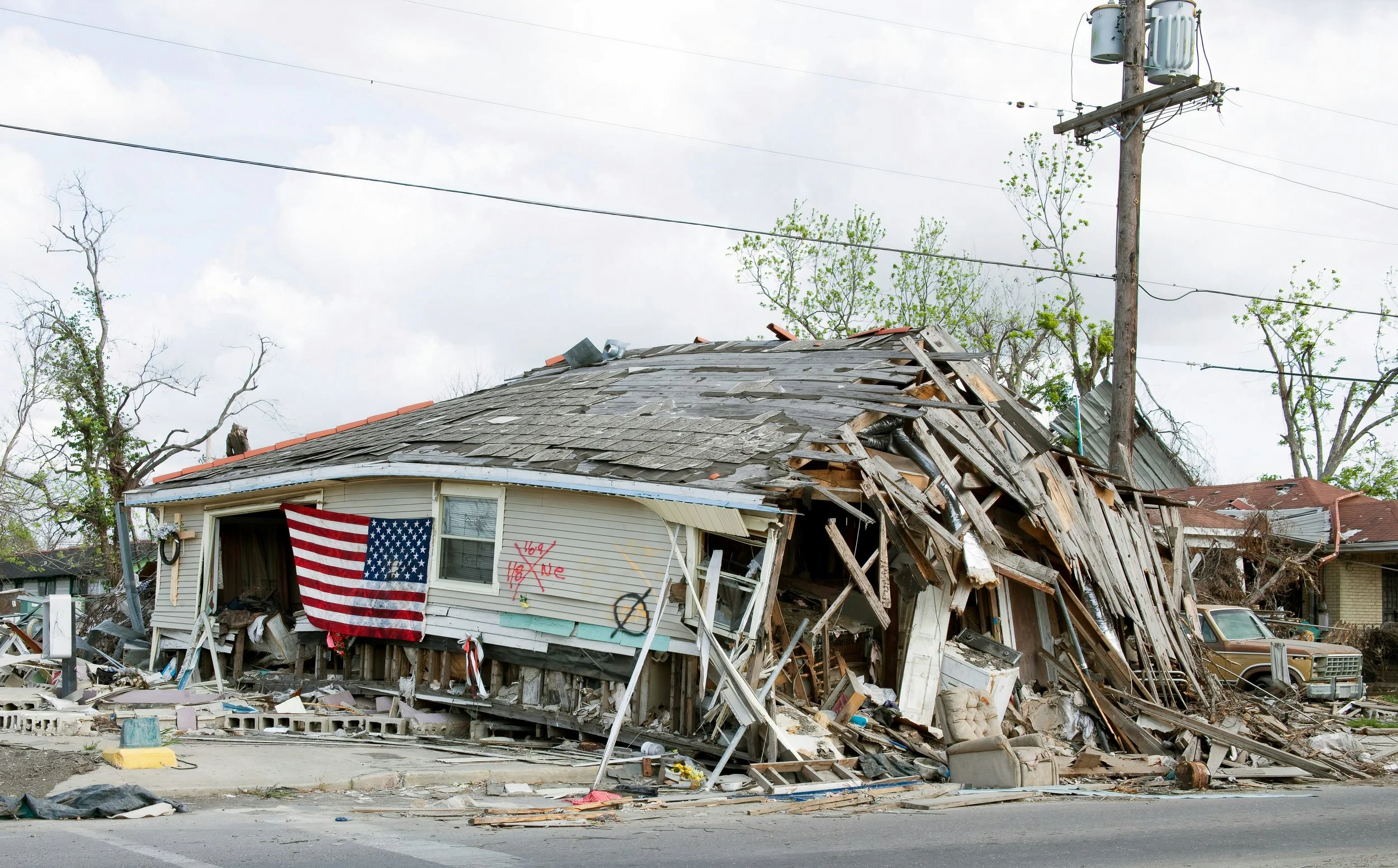
Storm aftermath (image source: Library of Congress_Unsplash)
Do Americans Believe Climate Change Is Real or a “Con Job”?
Before lifting the veil further on what we’ve known for decades about carbon emissions and global warming, it makes sense to ask what we know about public opinion on the issue — whether Americans think global warming is real or a hoax.
According to public opinion surveys conducted by Stanford University, a robust majority of Americans have little or no doubt about the existence of global warming, its impacts, and looming threats.
Here are some highlights from surveys conducted by Stanford University researchers over many years:
Public Opinion Trends on Global Warming (1997–2024)
1. “Percent of Americans Who Believed That Global Warming Has Probably Been Happening”
On average, during the years spanning 1997 to 2024, roughly 73% to 85% of Americans have believed that global warming is probably real.
As Stanford researchers put it: “These percentages suggest remarkable and consistent agreement” about the science of global warming.
2. “Of the Americans Who Believed That the Earth’s Temperature Has Been Going Up, the Percent Who Were Extremely or Very Sure”
In 1997 — 45% of Americans were “extremely sure” or “very sure” that the Earth’s temperature has been going up
In 2024 — 66% of Americans were “extremely sure” or “very sure” that the Earth’s temperature has been going up
Likewise, the percentage of Americans who were “extremely sure” or “very sure” that the Earth’s temperature will go up over the next 100 years — climbed from 45% in 1997 to 68% in 2024.
3. The percentage of Americans who have felt “extremely sure” or “very sure” that global temperatures would NOT increase over the next 100 years.
In 1997 — only 36% of Americans “were very sure global temperatures were not going up”
In 2024 — the number of Americans who felt sure global warming is not real was just 33%
4. A very significant majority of Americans have believed for almost two decades that human action is at least partly causing global warming:
In 1997 — 81% of Americans believed human action is a cause of global warming
In 2024 — 83% of Americans believed human action is a cause of global warming
5. A significant majority of Americans also believe that global warming will have severe impacts:
From 1997 to 2024, the Stanford surveys found that, on average, between 76% and 85% of Americans have believed that global warming will be a very or somewhat serious problem for the world.
Contrarian Perspectives
Even those who are skeptical about global warming — such as policy experts with the Heritage Foundation — acknowledge that greenhouse gas emissions have increased significantly (“globally, human beings are releasing more greenhouse gases than ever before”).
However, these same researchers push back against climate activism and what they call “climate alarmism.”
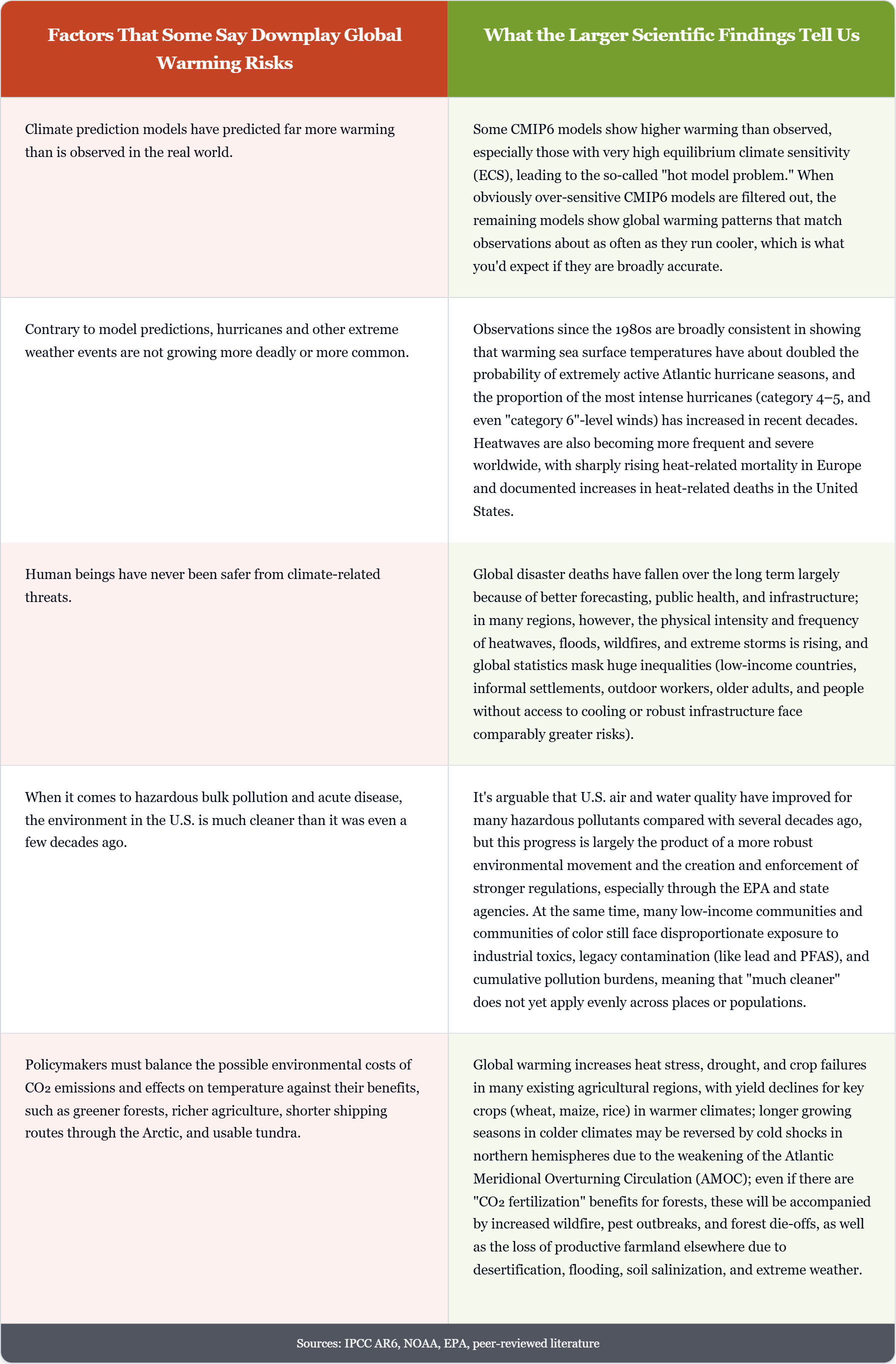
Conservatives with the Heritage Foundation, positing that concerns about climate change are overblown, highlight the following claims:
Models have predicted far more warming than is observed in the real world.
Contrary to model predictions, hurricanes and other extreme weather events are not growing more deadly or more common.
Human beings today have never been safer from climate-related threats.
When it comes to hazardous bulk pollution and acute disease, the environment in the U.S. is much cleaner than it was even a few decades ago.
Policymakers must balance the possible environmental costs of CO2 emissions and effects on temperature against the benefits of warming temperatures, such as greener forests, richer agriculture, shorter shipping routes through the Arctic, and usable tundra.
Many of the factors listed above are localized or temporary but not really reflecting the bigger picture. As for the purported “benefits” of warming temperatures, scientific assessments generally emphasize that even where limited benefits occur, they are usually outweighed by broader economic, ecological, and social costs.
Climate Science vs. Climate Denial: Competing Claims
Exploring scientific views of the impact of global warming — for further reading:
Confronting Earth System Model trends with observations | Science Advances
Extreme Atlantic hurricane seasons made twice as likely by ocean warming
Heatwave deaths increased across almost all Europe in 2023, says UN weather agency
Heatwave deaths increased across almost all Europe in 2023, says UN weather agency
Food, Fibre and Other Ecosystem Products
The CRBA Writers Team pledges to share climate truths you can trust — not noise.
Sharing information grounded in facts, science, reputable media, and cited openly, our work cuts through disinformation to empower our community toward climate action and justice.
Who Does Climate Denialism Serve?
While there may be legitimate debate around the most effective ways to communicate about or address global warming, denying its existence makes little sense.
Some aspects of climate modeling are complex and continue to be refined. But the basic science behind global warming is straightforward.
✔️ Over the past century, global carbon emissions have risen from about 4–5 billion tons per year to more than 35 billion tons today, largely due to the burning of coal, oil, and natural gas.
✔️ Earth’s atmosphere traps heat. Without this natural greenhouse effect, the planet would be far too cold to support human life.
✔️ Carbon dioxide and other greenhouse gases increase the atmosphere’s heat-trapping capacity. When their concentration rises, more heat is retained in the climate system.
Taken together, these facts provide the foundation for climate science. By measuring how much greenhouse gas is emitted each year and how strongly those gases trap heat, scientists can estimate how global temperatures will respond over time.
The costs of climate change are already adding up…
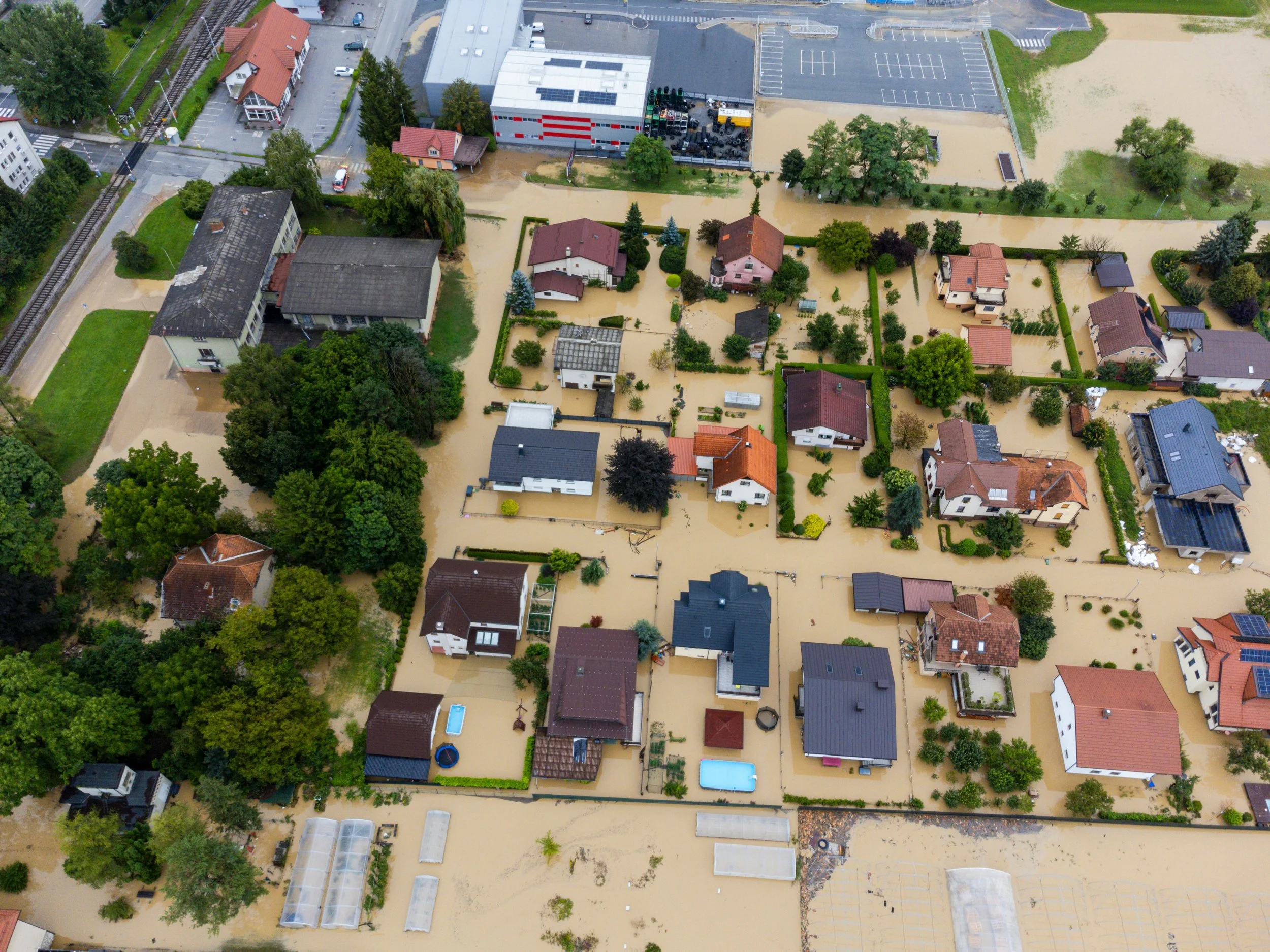
In addition to what we know about the science behind global warming, we also have lots of evidence about the consequences for the planet and life on the planet.
Across economies, ecosystems, and communities, researchers are increasingly able to measure the scale of these impacts.
Monetary costs
According to reporting by the Wall Street Journal and a 2022 report from the Deloitte Centre for Sustainable Progress, climate change, if left unchecked, could cost the global economy $178 trillion in present dollars from 2021 to 2070. This represents a 7.6% cut to global GDP in 2070 alone, driven by climate-related, resource, and productivity losses.
Biodiversity and ecosystem costs
According to assessments by the Intergovernmental Science-Policy Platform on Biodiversity and Ecosystem Services (IPBES), around one million plant and animal species are now threatened with extinction, with climate change increasingly accelerating habitat loss, coral reef collapse, forest die-offs, and disruptions to ecosystems that support food systems and human livelihoods.
Human costs
According to World Economic Forum reporting, Climate change has caused an estimated 4 million deaths since 2000 due to heatwaves, floods, droughts, wildfires, and disease, and could lead to some 14.5 million deaths by 2050.
Political and social costs
The World Bank estimates that failure to address climate change will result, over the next twenty-five years, in the forced migration of more than 140 million people in Sub-Saharan Africa, Latin America, and South Asia.
Taken together, the evidence paints a stark picture: the impacts of climate change are not theoretical and are already measurable across economies, ecosystems, and human societies.
Why Does Climate Change Denialism Persist?..
Fear & Uncertainty
Some people reject the scientific findings simply because the implications are frightening — what Al Gore once called an “inconvenient truth.” Fear and uncertainty can make denial an understandable human response.
But climate misinformation is not driven by psychology alone.
Disinformation
False narratives have also been systematically amplified through well-funded campaigns, especially by industries that profit from continued dependence on fossil fuels, particularly large petrochemical companies.
Similar to the ways tobacco companies once funded efforts to downplay the health effects of nicotine and smoking despite research findings to the contrary, major oil interests have funded think tanks, PR firms, and sympathetic “experts” in coordinated disinformation campaigns that foster public skepticism about mainstream climate science.
These efforts have been reinforced through political influence, including direct campaign contributions to legislative allies.
All of this occurred even as industry scientists warned executives decades ago that burning oil, gas, and coal would warm the planet and raise sea levels.
Climate misinformation is not driven by psychology alone. False narratives have also been systematically amplified through well-funded campaigns by industries that profit from continued dependence on fossil fuels — similar to the ways tobacco companies funded efforts to downplay the health effects of nicotine and smoking.
Politically, climate denial persists in part because fully accepting the science would justify stronger regulation of fossil fuels, threaten powerful donors’ business models, and challenge political affinities to the extent that environmental issues are lightening rod issues, similar to views about abortion laws, LGBTQ rights, and gun laws.
The result is a manufactured appearance of scientific disagreement, which can slow public action despite overwhelming evidence that climate change is largely driven by human activity.
For more on Climate Denialism see:
John Cook, “A brief history of fossil-fuelled climate denial,” in: The Conversation, 20 June, 2016 – overview of how fossil fuel companies funded think tanks and front groups to spread climate misinformation
Greenpeace USA, “Exxon’s Climate Denial History: A Timeline” – detailed timeline of Exxon’s funding of denial groups, deceptive research, and political influence campaigns
Union of Concerned Scientists, “The Climate Deception Dossiers” – leaked documents showing major fossil fuel companies knew the risks of climate change while publicly sowing doubt
U.S. Senator Sheldon Whitehouse, chapter from the Senate Climate Crisis report in “Dark Money” — an exposé of “dark money” networks and efforts to fund a coordinated campaign to obstruct climate policy and amplify denial talking points
“Cities Sue Big Oil for Damages From Rising Seas,” Scientific American, 21 Sept., 2017
Global Warming — Well Established But Inconvenient Truths
Did you know that the science of global warming dates back more than a hundred years, and that oil industry executives were some of the first people to hear about it?
Almost 70 years ago — at the Energy and Man Symposium (in 1959), the famous physicist Edward Teller explained the “greenhouse effect” to an audience of powerbrokers — not just economists and government officials, but including hundreds of oil industry executives as well.
Whenever you burn conventional fuel, you create carbon dioxide. [....] The carbon dioxide is invisible, it is transparent, you can’t smell it, it is not dangerous to health, so why should one worry about it?
Carbon dioxide has a strange property. It transmits visible light but it absorbs the infrared radiation which is emitted from the earth. Its presence in the atmosphere causes a greenhouse effect [....] It has been calculated that a temperature rise corresponding to a 10 per cent increase in carbon dioxide will be sufficient to melt the icecap and submerge New York. All the coastal cities would be covered, and since a considerable percentage of the human race lives in coastal regions, I think that this chemical contamination is more serious than most people tend to believe. (Emphasis added.)
And, 9 years later… Stanford researcher Elmer Robinson, warned in a report to the American Petroleum Institute, warned:
Rising CO2 would result in increases in temperature at the earth’s surface, and that significant temperature increase could lead to melting ice caps, rising seas, and potentially serious environmental damage worldwide… There seems to be no doubt that the potential damage to our environment could be severe… (Emphasis added.)
Almost 70 years ago, the famous physicist Edward Teller explained the “greenhouse effect” to an audience of hundreds of oil industry executives, as well as economists, and government officials, warning them that “this chemical contamination [rising CO2] is more serious than most people tend to believe.”
Measuring Global Warming Trends
Some will wonder, are the extreme storms and fire events often reported in the news in past years really signs of a changing climate? — Or just the kind of disasters we’ve always faced from time to time?
One way researchers look at this question is through the lens of weather modeling studies.
Climate Modeling
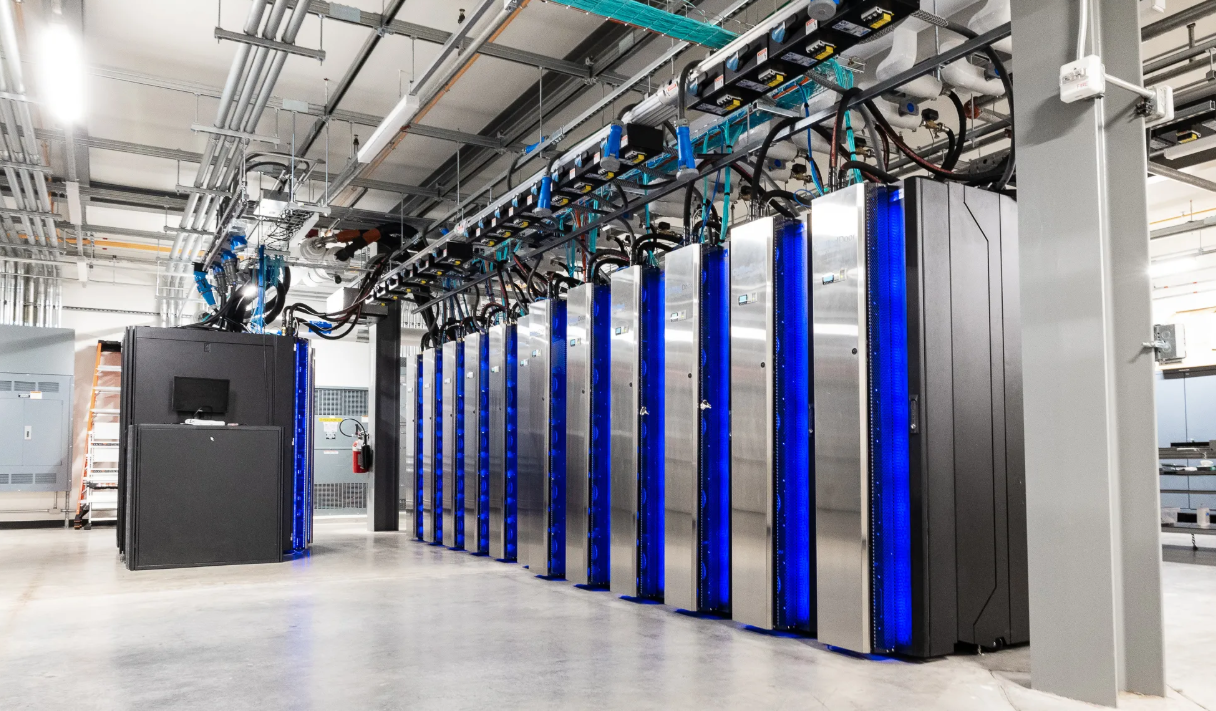
Global climate models are computer programs that consist of several hundred thousand lines of code.
They calculate the interactions between the ocean, atmosphere and land using factors such as water vapor, carbon dioxide, heat, and the Earth’s rotation as inputs.
Climate models project climate (the average weather over a long period of time, e.g., a 30-year period), not weather (what an area experiences on an hourly or daily basis).
Models help us understand how our actions can affect the future climate. They allow modelers to look at different scenarios of increased greenhouse gas emissions and see how those increases may affect the planet.
Based on this kind of modeling and the use of scientific controls and peer reviews, an overview from the World Weather Attribution Group presented findings from studies of 22 major heatwaves, floods, storms, droughts, and wildfires in 2025.
The Group concluded that despite the cooling effects of the year’s La Nina weather pattern, human‑driven warming clearly increased the likelihood and intensity of many of the year’s extreme weather events.
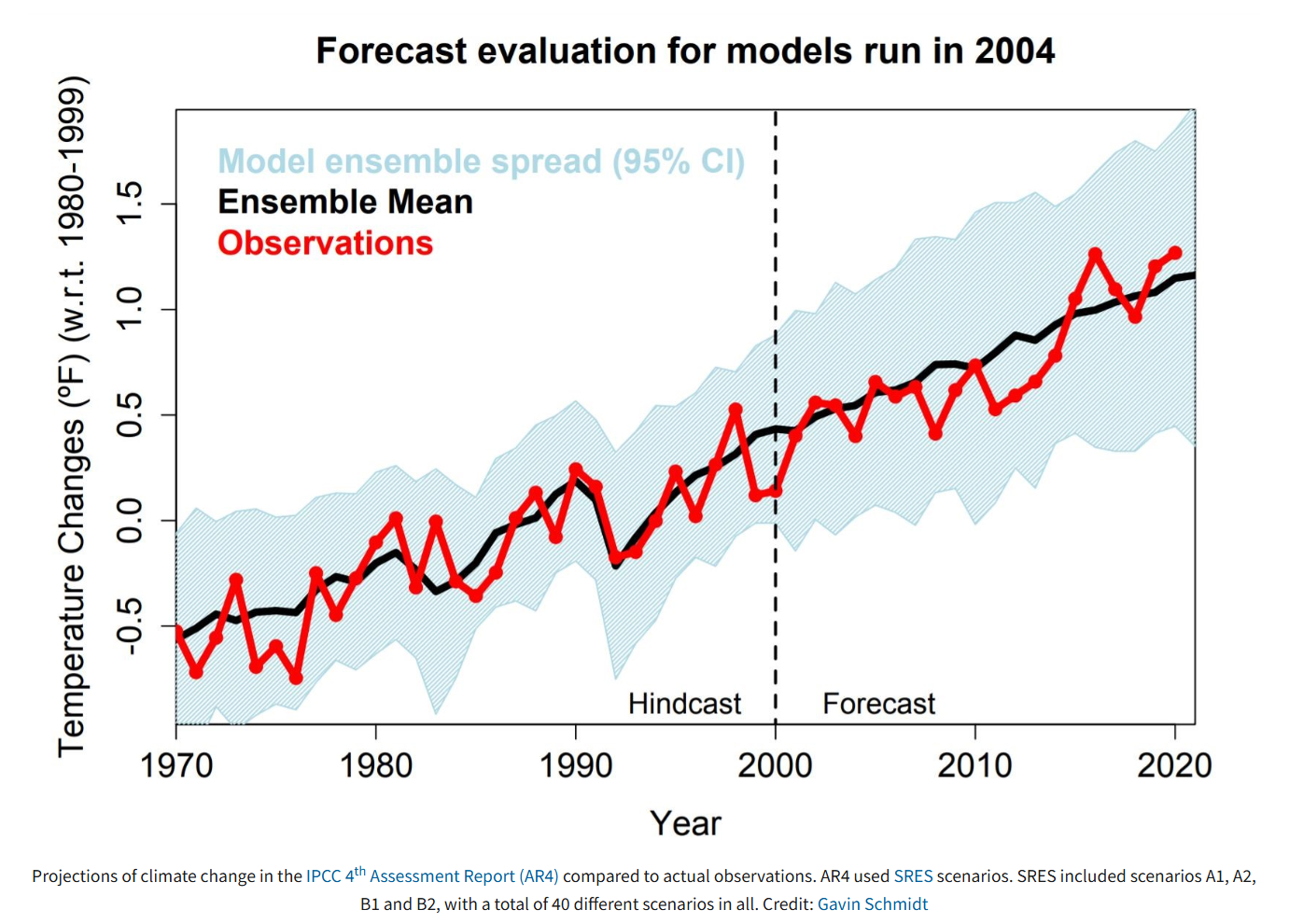
World Weather Attribution studies entail well-established scientific methods, including:
several steps to determine whether, and to what extent, an extreme weather event has been influenced by climate change
a methodology developed over time and peer-reviewed
application across a large number of studies (more than 100), with about 1 in 4 studies published in peer-reviewed journals
(Image credit: Gavin Smith; image source: USDA Climate Hub)
Some Key Findings From Recent Weather Attribution Studies
Although 2025 was slightly cooler than 2024 globally, it was still far hotter than almost any other year on record (Copernicus 2025) and the impacts of this hotness were unmistakable.
Revisiting some of the recent heatwaves studied in previous years such as extreme heat in the Amazon or Burkina Faso and Mali, researchers found these events to have become almost ten times more likely since 2015.
Even in a year that had weak La Nina conditions (NASA, 2025) that led to lower sea surface temperatures, global temperatures remained very high.
Significant harm from human-induced climate change is very real. And, it is not just a future threat, but a present day reality.
The Growing Climate Change Price Tag
Another way researchers at organizations such as NOAA and Climate Central try to measure weather and climate trends is by the growing financial costs that come with global warming and extreme weather.
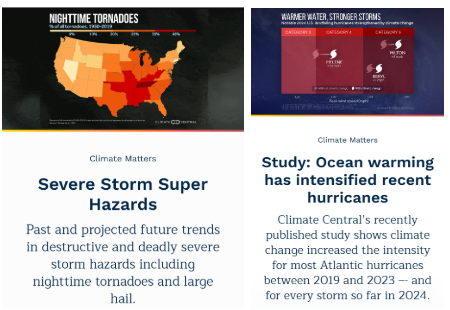
Climate Central is a policy-neutral 501(c)(3) nonprofit led by an independent group of scientists and communicators who research and report the facts about our changing climate and how it affects people’s lives.
Among other services, Climate Central produces Climate Matters — data-driven climate reporting that connects global climate change to local audiences in ways that matter.
Here’s what people should know about the growing impacts of extreme weather:
2025 ranks as the third-highest year (after 2023 and 2024) for billion-dollar weather and climate disasters — with 23 such events costing a total of $115 billion in damages.
The frequency of U.S. billion-dollar disasters has increased dramatically since 1980 due to the rise in extreme weather — up from about 3 disasters per year in the 1980s to about 20 per year over 2016–2025. (Since 1980, the U.S. has sustained 426 billion-dollar disasters, with a total cost exceeding $3.1 trillion.)
A billion-dollar drought affected the western U.S. in 2025. This event was primarily driven by heat, rather than by a lack of precipitation. This is consistent with an emerging trend of heat-driven drought in the western U.S.
The catastrophic flash flooding in the Texas Hill Country in July 2025 was one of the deadliest inland floods in U.S. history. This event did not result in losses of at least $1 billion, underscoring that the full toll of extreme weather events isn’t reflected in dollar-value losses alone.
Sources:
“2025 in Review: U.S. Billion-Dollar Disasters,” Climate Central
“Billion Dollar Weather and Climate Disasters,” NOAA, National Center for Environmental Information
What Happens When Climate Denialism Turns Into Climate Policy?
When climate denialism drives climate policy, federal policy changes and cutbacks aren’t limited to so-called trimming waste or improving spending controls. In fact, the aggressive federal cutbacks are not only impacting climate agencies and climate research.
This time, bedrock pillars of climate policy are being undone, such as scientific authority, statutory regulation, international commitments, state leadership, and clean energy investment.
Some of the current cuts and reversals are even targeting programs and commitments that have enjoyed strong bipartisan support.
What Federal Climate Inaction Looks Like in Action…
Undermining Core Climate Science
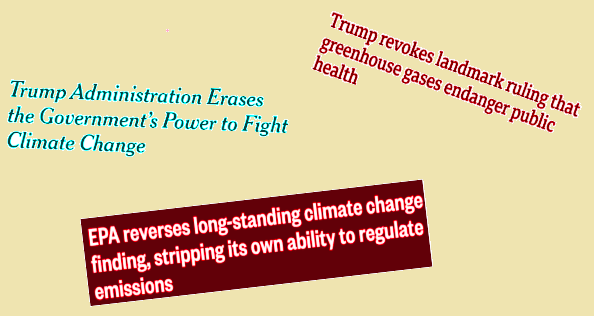
Moving to repeal the 2009 greenhouse-gas “endangerment finding,” the legal basis for regulating CO₂ under the Clean Air Act
Shutting down the EPA’s Office of Research and Development (ORD), eliminating a major source of independent environmental research
Politically sidelining career scientists, prompting a formal “Declaration of Dissent” from EPA staff
Weakening Statutory and Regulatory Authority
Efforts to narrow the EPA’s authority under the Clean Air Act
Moves to challenge or restrict California’s Clean Air Act waiver, long a driver of stronger vehicle emissions standards
Retreating from International Climate Commitments
Steps to withdraw from or diminish U.S. participation in the Paris Climate Agreement and related global climate initiatives
Pulling back from leadership roles in international climate efforts such as the Global Methane Pledge and global climate finance initiatives supporting vulnerable countries
Disrupting Federal Climate Investment
Terminating or freezing Inflation Reduction Act–funded grants and clean-energy incentives
Suspending or delaying hazard-mitigation and climate-resilience funding streams
Expanding Fossil Fuel Development
Accelerating oil and gas leasing on federal lands and offshore areas
Rolling back methane and other emissions regulations for fossil-fuel operations
Taken together, these actions will not only slow climate progress. They will also erode the scientific and policy foundations that federal agencies and local communities depend on to understand climate risks and prepare for a rapidly changing climate.
Taking Action — Standing Up Together
If there’s any silver lining, it may be this: that these attacks on science, truth, and public safety inspire more people than ever to step forward as climate action leaders.
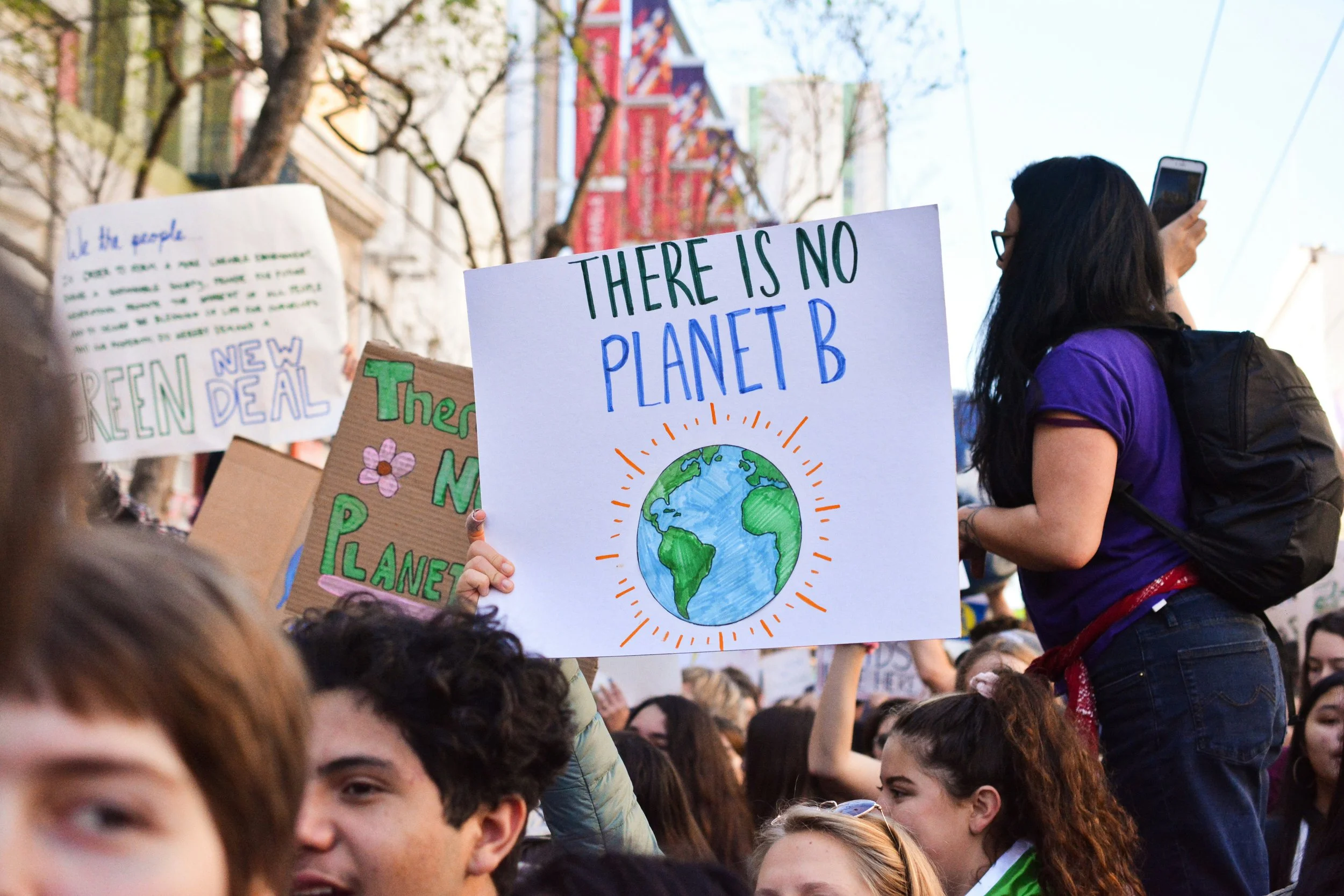
Are you ready to step up?
By joining up with The Climate Reality Project and our local Climate Reality Bay Area Chapter (CRBA), you’re able to engage with local communities to support an organization that’s making a difference locally, nationally, and globally.
Once a member, you can begin to connect, learn, and support urgent, targeted actions.
It’s hard to imagine a time when getting connected and going deeper could matter more than it does now!
The mission of the national Climate Reality Project is to recruit, train, and mobilize people of all ages and backgrounds to work for just climate solutions that speed the global transition from dirty fossil fuels to clean, renewable energy.
Ready to get connected with Climate Reality’s Bay Area Chapter?..
Already connected, but interested in leveling up and engaging further?..
Here’s a snapshot of some of the most urgent local and statewide flashpoints we’ve got our eyes on in 2026 along with a snapshot of ways local residents can engage in the work of CRBA.
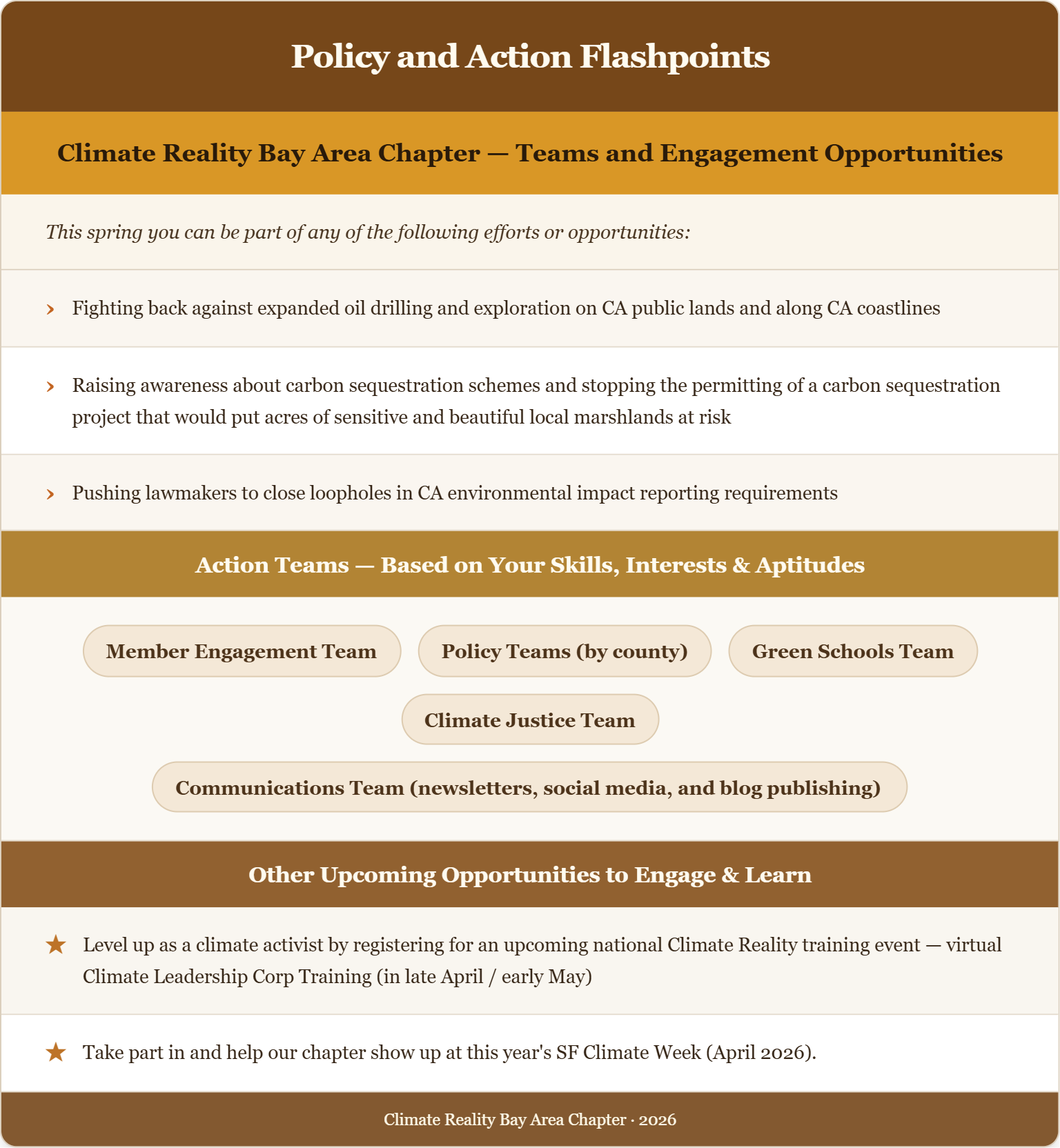
After everything we’ve covered in this series, the takeaway is not just a list of risks and impacts, it’s also about what’s possible when people are informed, engaged, and ready to act.
With truth on our side and a large majority of Americans growing more concerned about the impacts of climate change, our community and others like it are poised to help step into the gap left by the waning federal leadership on climate. So, yes, action still matters, and we hope you’ll be stepping up soon!
Need some more motivation?… Here’s a real espresso shot of insight, urgency, and inspiration. ☕💡
If you’re still on the fence about getting more involved, we promise this keynote speech, from Climate Reality Project founder Al Gore (delivered at last year’s SF Climate Week Conference), will help you get energized!
Use the link below to listen!
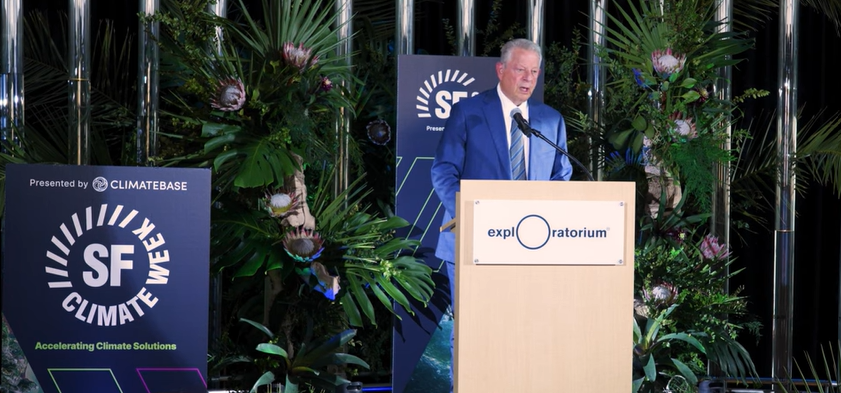
SF Climate Week Conference, 2025
To learn more about the federal retreat from climate action and about other climate topics and resources, check out other posts in this series:
Part 1: Mapping the Federal Retreat From Climate Action (Overview)
Part 3: Water Frontlines: How Federal Cuts May Increase Flood and Sea Level Risks in the Bay Area
Part 4: The Climate Safety Net: How Federal Climate Systems Quietly Support Local Resilience
Author Bio
Keith Nickolaus is a communications professional and former educator based in Berkeley. As leader of the CRBA Writers Team, he works to amplify community voices and is passionate about informing and inspiring climate action across the Bay Area.
Climate Writers Wanted…
Do you have a passion for writing?
Want to help us educate and mobilize local readers concerned about global warming?
By joining the CRBA Writers Team you’ll help us to:
raise awareness about key climate efforts
keep members and other local residents informed about relevant and pressing climate issues impacting the SF Bay Region
share inspirational climate and action experiences from our chapter members
mobilize residents all around the greater SF Bay Region to take part in climate campaigns and events
If you want to find out more about joining the CRBA Writers Team and discussing what level of engagement is right for you, please contact Keith, CRBA Writers Team Lead, at crbawriters@gmail.com