
Is Rooftop Solar Still Worth It in California?
By Keith Nickolaus, PhD, CRBA Writers Team
Are you thinking about rooftop solar for your home, but wondering if the upfront costs are worth it, now that past incentives have been phased out?
The truth is that installing rooftop solar can add value to your home and deliver meaningful financial benefits year after year — cutting utility bills in the short-term and helping you get a substantial return on investment over the longer term — especially if you’re ready to consider pairing solar panels with a battery system.
Can’t swing the upfront costs? You may find that leasing offers you the option you need.
In this post — with the help of Bay Area climate advocate and author James Leach, we provide a helpful guide for homeowners’ decision making, including:
a quick primer on rooftop solar incentives and contracts (for readers who find it helpful)
a snapshot of what’s changed with NEM 3.0 and how lost incentives countered by rising electricity rates impact the financial calculus of purchasing rooftop solar
a breakdown of why homeowners still have an opportunity — even under NEM 3.0 — to help save the planet and achieve a respectable return on investment over time
an brief overview of the pros and cons of owning vs. leasing rooftop solar
tips for how to navigate your own rooftop solar project

Overview
California’s transition to Net Energy Metering 3.0 (NEM 3.0) has led many homeowners to assume rooftop solar no longer makes financial sense. The reality is more nuanced.
Back in the day, rooftop solar incentives allowed homeowners to get paid for any surplus energy they generated. Unfortunately, this kind of incentive — where PG&E pays you for surplus electricity — has long been phased out.
Even without as many incentives, however, meaningful cost savings are still in store for homeowners who install rooftop solar, especially when paired with battery systems.
If you’re feeling a little fuzzy about California NEM agreements and how they’ve evolved over the past twenty years or so, it’s key to remember that even with rooftop solar, your home and your solar system, and the utility grid are all interconnected — making for a more complex billing structure for your electricity use.
Understanding the ROOFTOP SOLAR ←→ UTILITY GRID loop and NEM contracts
Sending electricity to the grid…
On a sunny day, with rooftop solar, you’ll most likely be generating all the electricity you’re using, plus some surplus. That surplus will go through your meter back to the grid.
Drawing electricity from the grid…
At night, when your system produces no electricity, any electric power your home uses will come through your meter from the grid (or it will come first from your battery system, if you have one, and then from the grid as needed).
Because of these electricity loops between the grid (utility) and a home with solar panels, utilities need more complex contracts for homeowners who install rooftop solar.
These contracts — Net Energy Metering contracts — spell out how you’re credited for the electricity you send to the grid (as an electricity producer), and the rates you’re charged for any electricity you draw from the grid.
The net difference (between what you send to the grid and what you take from the grid, adjusted for the value assigned to these swaps by your designated net metering contract) = your net energy usage.
Today, California is in the third phase or iteration of these net energy metering contracts, called NEM 3.0.
From NEM 1.0 to NEM 3.0 — A Quick (Simplified) Recap
NEM 1.0 (phased out by PG&E at the end of 2016)
Under this first tier of rooftop solar incentives, excess electricity sent to the grid was effectively credited at the same retail rate homeowners paid for electricity. This meant you saved money on two fronts:
you needed less electricity from the grid (self-generation), and
any surplus electricity you generated would generate a payback for additional savings
NEM 2.0 (phased out by PG&E in April 2023)
Under this second iteration, homeowners no longer received full retail “value” in quite the same way for their surplus electricity, but still received bill credits for excess electricity sent to the grid, typically close to retail rates, applied over a 12-month period.
At the end of the year, the utility issues a “true-up” bill based on net energy use:
If you generated as much or more electricity than you used, your bill could be reduced to near zero (but with only minimal compensation for excess generation).
If you used more than you generated, you would for the net difference at the end of each 12-month cycle.
(NEM 2.0 also introduced time-of-use rates and some additional fees, further reducing overall benefits for most homeowners.)
Key Difference Between NEM 1.0 and NEM 2.0
Under NEM 2.0, homeowners no longer received meaningful compensation for their surplus electricity, beyond bill credits, but could still offset most or all of their electricity use over a 12-month cycle, paying little or nothing when the true-up bill arrived.
NEM 3.0 (in effect since April/May 2023)
NEM 3.0 is similar in structure to NEM 2.0, but with one major change: the electricity you send to the grid is now credited at much lower, time-varying rates based on the utility’s avoided cost — often far below the retail price you pay for electricity.
Key Difference Between NEM 2.0 and NEM 3.0
Under NEM 3.0, you still receive credits for excess electricity sent to the grid, but those credits are significantly lower than the retail price of the electricity you consume from the grid and lower than what homeowners received under NEM 2.0.
Now you can see why, under NEM 3.0, many residents no longer see much cost-savings incentives for installing rooftop solar.
But, while NEM 3.0 contracts have less favorable terms than earlier net metering agreements, there are still significant potential cost savings — and greater savings the more electricity rates rise — and especially when pairing your rooftop solar with battery storage.
After NEM 3.0 went into effect it was widely publicized to have resulted in a much longer payback period (11-12 years). But when the cost of electricity went up significantly it changed the cost-benefit analysis for homeowners — basically bringing the time to payback and the 25-year average ROI to something more favorable, very close to what it was before NEM 3.0.
— James Leach (Bay Area resident and author of The Renewable Way and The Sustainable Way)
Key Takeaways
The rising cost of electricity changes the calculus: While it takes longer to benefit financially from rooftop solar under NEM 3.0, the high price of electricity is becoming a new incentive in its own right — making the break-even period closer to 8-to-12 years instead of 20+ years.
Rooftop solar means less exposure to electricity rate inflation: If electricity rates continue to increase, rooftop solar will insulate you from those costs and deliver a better long-term payoff.
Battery systems may make the difference: with earlier incentives phased out, sending surplus electricity to the grid no longer drives your real savings; this makes storing and using more of the energy your panels produce crucial for realizing long-term benefits under NEM 3.0.
The more you rely on electricity, the more you’ll save: over time, if you replace gas appliances with electric ones and gas-powered vehicles with EVs, you’ll power more of your life with free energy you get from the sun and reduce your overall energy costs.

📣NEM 3.0 in the News
The Fight to Reinstate Rooftop Solar Incentives
In 2025, a coalition of environmental groups fought to protect incentives for rooftop solar, filing a lawsuit against the CPUC, contesting the CPUC’s rule-making process for NEM 3.0.
In March 2026, the appeals court ruled against the environmental groups and in favor of the CPUC.
This recent ruling means NEM 3.0 remains as is, at least for now.
Photo credit: Solar Rights Alliance
The CRBA Writers Team pledges to share climate truths you can trust — not noise.
Sharing information grounded in facts, science, reputable media, and cited openly, our work cuts through disinformation to empower our community toward climate action and justice.
Will Installing Rooftop Solar Still Payoff? — What a Net Present Value Analysis (NPV) Reveals
While you can cut your electricity bill by installing rooftop solar, you still need to ask yourself if the steep upfront costs are really worth it, for your budget and based on your own circumstances.
Doing a Net Present Value Analysis, or NPV, is an objective way to see if such an investment really pays off.
Below, you’ll see what this looks like using a conservative real-world scenario for a small northern California home.
Even after factoring in very conservative figures for total energy consumption and lots of foggy weather, we found that installing a solar + battery system can still generate meaningful savings over time — even under Net Energy Metering 3.0.
Even after factoring in very conservative figures for total energy consumption and lots of foggy weather, we found that installing a solar + battery system can still generate meaningful savings over time — even under Net Energy Metering 3.0.
A Conservative NPV Model for Installing Rooftop Solar + Battery System
1. Upfront Investment
Estimated system cost (solar + battery + installation): ~$30,000 (for smaller homes)
2. Year 1 Snapshot
Annual electricity cost without solar: ~$4,058
Annual electricity cost with solar + battery: ~$713
Year 1 savings: ~$3,345

3. Break-Even Point
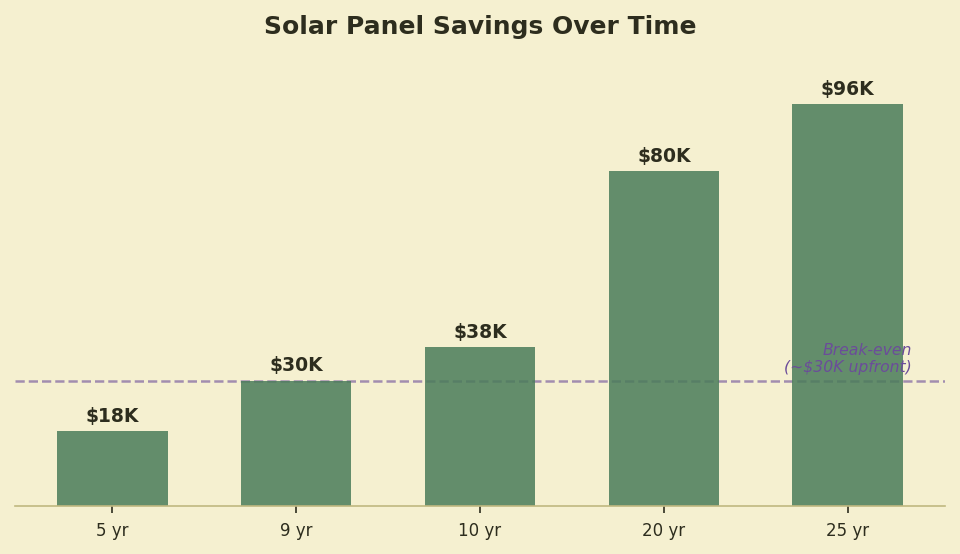
Because annual savings compound over time (and utility rates tend to rise), the system’s break-even point — the point where cumulative savings match the upfront cost — occurs at approximately YEAR 9 in this scenario.
After that point, the system effectively generates net financial gain year over year.
4. Savings That Accumulate Over Time
Assuming an estimated ~$4k in annual electric bill savings…
~9 years = break-even on initial pay out for solar + battery system
~10 years = cumulative savings of ~$38k for a ~$8k net positive payback
~20 years = cumulative savings of ~$80k for a ~$50k net positive payback
~25 years = cumulative savings of ~96k for a ~$66k net positive payback
My Net Present Value analysis reveals a positive return on investment for rooftop solar, even under NEM 3.0. Homeowners can achieve a 25-year annual return rate of nearly 11% (8% when adjusted for inflation). Any financial adviser will tell you that this is a solid return for a low-risk investment that is tax-free and increases the value of your home.
— James Leach (Bay Area resident and author of The Renewable Way and The Sustainable Way)
What This Means in Plain Terms
The system pays for itself in under a decade
After break-even, savings continue to accumulate for another 15+ years
Long-term returns can reach 8–11% annually, depending on electricity inflation
A Note on Scenario Assumptions (Conservative Case)
To keep this analysis grounded and realistic, the model is based on a relatively modest and conservative household profile:
Home size: Smaller to mid-size residence (~1,200 sq. ft.)
Energy profile: Fully electric home (but not including electric vehicle charging)
Location: Coastal California climate with frequent fog and cloud cover (moderate or below-average solar production)
This scenario does not represent a best-case outcome.

Homes that:
receive more direct sunlight
use more electricity during peak hours (e.g., air conditioning; larger homes)
include EV charging
or face higher future utility rate increases …
may see faster payback periods and significantly higher lifetime savings.
Frequently Asked Questions
Is rooftop solar still a good investment under NEM 3.0?
Yes — when paired with battery storage, solar can still deliver strong long-term savings and competitive returns.
What’s the biggest misunderstanding about NEM 3.0?
Many homeowners still think solar works best by exporting energy, when in reality the value now comes from using your own electricity as electricity rates continue to go up.
Why doesn’t exporting solar energy drive savings anymore?
Export rates are now much lower — typically a fraction of retail electricity prices — so the credits you get for it under NEM 3.0 don’t do as much to offset your electricity bill.
Should homeowners invest in battery storage in addition to rooftop solar, and how much does it increase upfront costs?
Under Net Energy Metering 3.0, adding a battery is often what makes solar financially effective, since it allows homeowners to store and use their own energy instead of exporting it at low rates. It typically means increased upfront system costs (adding roughly 30–50% to the total investment), but significant improvement in long-term savings, reducing peak electricity purchases and providing backup power during outages.
What kind of savings can homeowners expect early on?
In many cases, homeowners can save several thousand dollars per year immediately after installation, but it takes longer to break even on the total upfront investment.
What does the long-term financial picture look like?
Over 20–25 years, total savings can approach or exceed $80,000–$100,000 (for a net savings between $40,000 to $70,000) depending on consumption habits, rooftop solar capacity, battery storage, and energy prices.
How should homeowners think about payback period vs. return?
While payback (the “break-even point”) may take 8 to 11 years, the long-term return can generate savings that far exceed the initial investment and which rival or exceed traditional low-risk investments.
What factors most affect ROI?
Key variables include electricity usage, peak demand patterns, local climate factors, and utility rate structures.
Who benefits the most from installing rooftop solar and battery storage under NEM 3.0?
Homes with higher electricity use, significant peak-time consumption, or electric vehicles tend to see the greatest savings, even more for homes with more abundant sunlight exposure.
How should homeowners think about the upfront cost?
While the initial investment is higher, long-term savings and rising electricity rates can make the system financially advantageous over time. Adding rooftop solar can also add incentives and benefits for homeowners still working to phase out gas appliances and/or gasoline-powered vehicles for electric ones.
What ongoing costs should be expected?
Homeowners should plan for periodic maintenance, and eventual battery replacement (typically around year 10–15).
Beyond Number Crunching: The Big Picture Benefits of Residential Solar
Higher Electric Bills = More Potential Savings
The bottom line is that under NEM 3.0 the financial incentives for investing in rooftop solar have indeed diminished.
On the other side of the equation, electricity rates have gone way up, even since NEM 2.0 was phased out in 2023.
This rising cost of electricity makes rooftop solar investments more and more attractive by the day, even under NEM 3.0.
Less Conservative Scenarios Will See Greater Payoffs
Keep in mind that the timeline we posited for breaking even on a solar + battery system investment (= 8 to 9 years) is based on a very conservative scenario (a small home using less electricity, with no EV charging, little air conditioning needs, and a cloudy climate where panels generate less electricity…).
If you adjust some of these assumptions for your own home size, climate, and total electricity consumption, you may find the cost/benefit analysis improves significantly. A reminder that each homeowner should use the modeling above as a rough illustration only.
Also, the math you do today may be based on how much electricity your home uses today, but the savings can increase further anytime you switch out a legacy gas appliance for an electric one, or you switch from a gas-powered vehicle to an EV.
Self-Reliance + Free Electricity
By generating your own power with rooftop solar, you’re also making yourself less reliant on PG&E (a profit-driven corporate monopoly) and insulating yourself from future electricity price spikes, and — with a battery system — you’re also protected against power outages, no matter how sudden, and including longer ones.
By adding an EV to your household mix, you’re also eliminating trips to the gas station and insulating yourself from price spikes at the gasoline pump as well!
Making a Difference for the Planet

Going all electric and investing in rooftop solar isn’t just about dollars and cents — it’s also an opportunity to help usher in a clean energy future for the planet and future generations.
As a homeowner with rooftop solar, your investment will not only give you more independence and long-term accumulated savings, you’ll also have the satisfaction of powering your home, all of its appliances, and maybe your car too, with clean, free, 100%-renewable energy, straight from the sun!
Going all electric and investing in rooftop solar is also an opportunity to help usher in a clean energy future for the planet and future generations.
How To Get Rooftop Solar for Your Home
If you’re interested in solar under Net Energy Metering 3.0, the key is to approach it as a whole-home energy strategy, not just a panel installation.
Here’s a simple path to get started:
☀️ 1. Assess Your Home’s Suitability
Start with a basic feasibility check:
Roof condition: If your roof is nearing end-of-life, consider replacing it before installing solar (some solar contractors partner with licensed roofing companies and may be able to get you a discounted quote for the work)
Sun exposure: South- or west-facing roofs with minimal shading perform best
Available space: Enough usable roof area for panels and (optionally) battery placement
Feasibility Pro Tips:
Keep in mind that many installers offer free remote assessments using satellite imagery to estimate solar potential.
Don’t forget to consider potential long-term changes to sun exposure. For examples, are there any zoning regulations in your community that protect the sun exposure your project will rely on? Are there any adjacent properties where new construction could impact your current sun exposure? How likely is such a prospect?
Pro Tip:Don’t go it alone when you don’t have to…
Want help navigating your rooftop solar and home electrification projects?
Getting help is much easier thanks to organizations that promote home electrification by offering free, personalized guidance for homeowners pursuing electrification projects, such as:
Developing a home energy-use profile
Assessing electrification readiness or needed upgrades
Determining project scope
Estimating project costs and benefits
Navigating the shifting local, state, and federal incentives landscape
Connecting with vetted contractors
Check out QuitCarbon for example, which offers all of the above to homeowners in its service area.
The Solar Rights Alliance is another helpful organization, offering free rooftop solar consumer guides online and helping homeowners track and advocate for better rooftop solar policies.
☀️ 2. Understand Your Energy Use
Review your last 12 months of electricity bills:
Total annual usage (kWh)
When you use energy (day vs. evening, peak vs. off-peak)
This step is critical under NEM 3.0, where timing of usage matters as much as total usage.
If you’re getting electric utility bills and use summaries in the mail, keep recent copies on hand or find out how to log into your online account.
Also, solar contractors can sometimes get this information for you or help you get it — which they use to estimate how much solar capacity you need and how much money you can save on your electricity bills over the short and long term.
☀️ 3. Get Multiple Quotes From Reputable Installers

Reach out to at least 2–3 licensed solar installers for proposals.
Look for:
System size (kW) and expected annual production
Battery storage options (capacity, backup capabilities)
Estimated savings and payback period
Total installed cost (before and after incentives)
☀️ 4. Factor-In Incentives and Financing
Be sure to account for:
Federal tax credits (Investment Tax Credit)
State or local incentives (where available)
Financing options (loans, leases, PPAs)
These can significantly reduce upfront costs making it possible to recoup your investment in a shorter time period.
☀️ 5. Compare Ownership vs. Leasing Options
Owning the system (purchase or loan):
Higher upfront cost
Greater long-term savings
Eligible for tax credits
Increases home value
Leasing or Power Purchase Agreements (PPAs):
Low or no upfront cost
Predictable monthly payments
Lower total savings over time
Provider owns and maintains the system
Solar leases can help you reduce your carbon footprint and save money on utility bills without investing a large sum of money upfront…
Buying solar panels is typically best for environmentally conscious homeowners who want a long-term renewable energy investment.
By buying your solar panels, you should be able to save more over time… You’ll also get more control over the system and a greater sense of ownership.
— Solar Panels: Lease vs. Buy, Consumer Affairs (accessed 13 March, 2026)
☀️ 6. Keep an Eye on Emerging Options
California is also exploring policies that could expand access to solar beyond traditional rooftop systems, including plug-in solar panels (smaller, modular systems that can connect directly to home circuits), or other models that could make solar more accessible to renters and multifamily households.
Final Thoughts
Determining if a rooftop solar investment will pay off takes a bit more number crunching these days — now that there are less incentives. But the transition from NEM 2.0 to NEM 3.0 doesn’t remove all incentives, far from it.
Whether you’re motivated by your household bottom line, concerns over global warming, or both, installing a solar + battery system — even today — could help you save money, add value to your home, increase your energy independence, and reduce your annual CO2 footprint.
About the Authors
Keith Nickolaus is a communications professional and former educator based in Berkeley. As leader of the CRBA Writers Team, he works to amplify community voices and is passionate about informing and inspiring climate action across the Bay Area.
Contributing author James Leach is a longtime CRBA activist and climate advocate, author of The Renewable Way and The Sustainable Way.
Please share your thoughts and comments below.
Have rooftop solar? What has your experience been like?
Thinking about getting rooftop solar?… What do you see as the biggest pros and cons, or biggest challenges?