Gambling With Public Safety: How Federal Cuts Are Compromising Bay Area Climate Resilience & Emergency Readiness
Mapping the Federal Retreat From Climate Action — Part 5
By Keith Nickolaus, PhD, CRBA Writers Team
This post is the fifth installment in our six-part series, Mapping the Federal Retreat From Climate Action.
Throughout this series we’ve examined how recent federal cutbacks to climate science, emergency preparedness programs, and key public agencies are reshaping environmental risk across the Greater San Francisco Bay region — why those changes matter locally, and how Bay Area communities can respond.
Our earlier posts explored the growing risks posed by wildfires and wildfire conditions, by flooding and rising sea levels, and as a result of the system gaps inflicted by federal cutbacks.
This final post examines concrete examples of how federal funding cuts, rescinded grants, and staffing reductions are affecting local resilience planning, emergency readiness, and public safety here in our own communities.
We will see examples of lost effort and momentum across a range of climate resilience and climate action initiatives, but we’ll also need to ponder other potential risks and threats the future may hold as a result of the compromises being made.
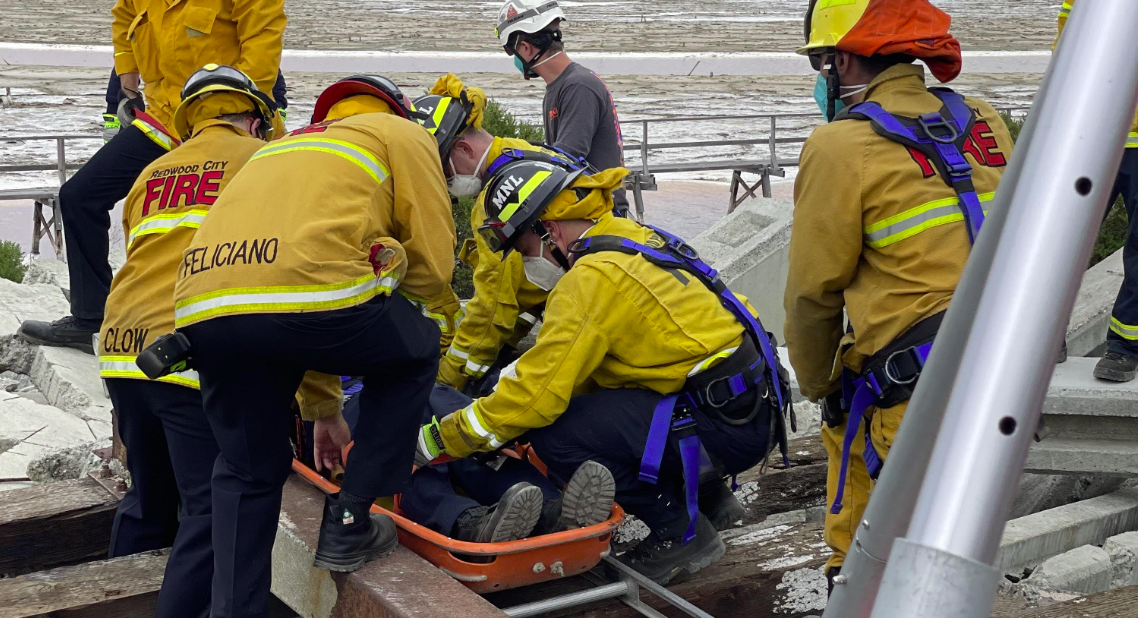
Search and Rescue Training (source: California Task Force 3)
Climate Change Risks: A Painful Truth
In the summer of 2025, extreme flooding in southern Texas led to a tragic loss of life. The intensity and speed of the disaster reflected the kinds of extreme events that climate scientists have been warning about.
In the aftermath of the tragedy, many experts emphasized a painful truth: while extreme weather itself cannot be prevented, public agencies can help reduce the scale of the losses and increase public safety. In fact, Bay Area earth scientist Lisa Micheli — who studies floods and their impacts — called the terrible loss of life that occurred from the flooding “absolutely preventable.” For Micheli the event was a reminder that making science into a political football will have life and death consequences for all of us (“Close to Home: Science is not just a ‘nice to have’,” Press Democrat, 17 July, 2025).
In the aftermath of the tragedy in south Texas, many experts emphasized a painful truth: while extreme weather itself cannot be prevented, public agencies can help reduce the scale of the losses and increase public safety.
Early warning systems, hazard mitigation planning, trained emergency teams, coordination across levels of government — sustained with consistent and adequate funding — are the practical building blocks of real public safety. When they weaken, disaster risks increase, and the risks are potentially compounded by cutbacks across networked climate initiatives:
efforts to reduce carbon emissions
investments in data collection and robust and reliable modeling
local actions informed by reliable data and adequate technical advising
resilience planning, and emergency response capacity and coordination
In our previous post in this series, we examined in greater depth how these overlapping agencies and resources function as a larger safety net, creating coordinated networks and systems supporting everything from research, forecasting, and technical expertise to environmental grant programs and emergency coordination. With an appropriate level of funding and coordination, these systems quietly support risk reduction and local preparedness.
Unfortunately cuts to agencies like NOAA, the EPA, and FEMA can create consequential system gaps — gaps that only become visible when risks increase and disasters occur.
In this post we’ll try to uncover some ways system gaps created by federal funding cuts and staff reductions are impacting the SF Bay and Delta Region in particular.
The CRBA Writers Team pledges to share climate truths you can trust — not noise.
With information grounded in facts, science, reputable media, and cited openly, our work cuts through disinformation to empower our community toward climate action and justice.
1. What’s Changing and Why It Matters Locally
Over the past year, federal climate and emergency preparedness programs have experienced significant disruption. While headlines often focus on national debates, this blog post series has been examining the links between these cuts and a range of potential impacts on local communities like ours:
Cuts to NOAA funding and workforce, threatening regional ocean observing systems, climate research, and upgrades to forecasting tools that inform flood, wildfire, and atmospheric river predictions
Workforce reductions at the EPA, including significant losses of scientific expertise, reductions in technical support capacity that supports local governments and agencies, and inter-agency restructuring that threatens the impact and integrity of key research functions
The termination or curtailment of numerous Inflation Reduction Act–funded grants and projects, including for grants and projects in the greater SF Bay Area that had already completed competitive review and approval processes
Termination or delay of FEMA hazard mitigation and resilience programs, including BRIC and Flood Mitigation Assistance grants that support Bay Area adaptation projects
Below you’ll find a closer look at impacts federal cuts are having in our own SF Bay Area communities — right now, and in terms of potential future impacts.
2. Environmental Grants: Now You See It, Now You Don’t
At agencies such as the EPA, grant programs support local planning, staffing, infrastructure upgrades, and community-based resilience efforts — often over multiple years. When those processes suddenly get upended, as is happening under the current leadership in Washington D.C., even local initiatives and commitments in our own neighborhoods are affected, with consequences that will ripple far into the future as well.
For example, after Trump took over again as President in January 2025, numerous grant funding streams were reduced or eliminated. Some of these — including ones poised to benefit Bay Area communities — were abruptly discontinued even after having already been finalized and implemented under formal federal contracts.
Retired Bay Area climate scientist Emily Pimentel was still with the EPA in early 2025 when the grants started to vanish. She recalled how some grants, significant ones, were just cut off, “boom, no explanation, nothing… We were told we could not reply, explain, talk to anyone. We were just given direction to stop. Clearly, this is not the way the EPA should be operating.”
Pimentel had a close up view of some of the significant Bay Area projects and communities affected when two sets of Biden-era IRA (Inflation Reduction Act) EPA grants funding climate resilience projects — some for up to $3M and others capped at $20M — were cut back.
$20M Grant to the Treasure Island Mobility Management Agency
This grant was to fund electric ferry charging infrastructure, upgrade Treasure Island transit services, and create transit initiatives to improve transit between Treasure Island and key locations in San Francisco.
Pimentel recounted how the grant funding for this project was eliminated without any explanation or justification:
This grant had gone through all the process of vetting you know, competition, rigorous review, and so on. I served as a project officer and there was a team of experienced individuals working on the project, many were new employees — amazing individuals with amazing education and relevant experience and exceptional promise. Because we had so many grants and we needed to have people who are experienced.
San Francisco District 6 Supervisor Matt Dorsey, said in a press release“The loss of EPA grant funding for Treasure Island Connects threatens critical programs like the free on-island shuttle and bikeshare that would have improved mobility for the residents and helped us reduce emissions and improve air quality.”
$18M grant for La Familia, a multicultural community services nonprofit in Sacramento.
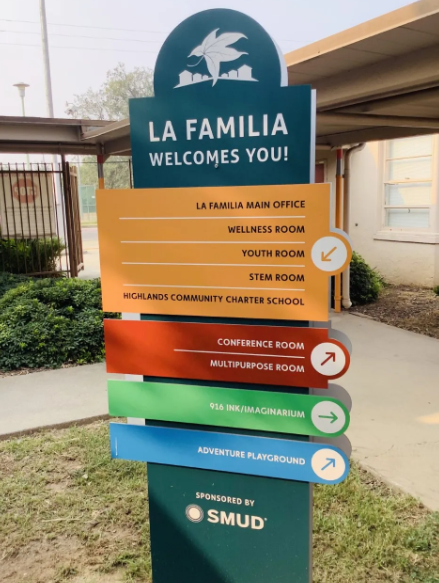
In late April of 2025, an $18.6 million grant to the Sacramento community nonprofit La Familia, for the creation of a new community resilience hub and park in south Sacramento, was abruptly terminated.
Pimentel had some direct connection to this grant as well. She told me that La Familia went through a competitive application process and rigorous evaluation steps.
The organization had a strong funding track record and had been fundraising for many years for the project which would have converted an old school site into a climate resilience center.
Even though the nonprofit La Familia, in Sacramento, went through a rigorous and competitive application process, their grant, for the development of a climate resilience center, was abruptly terminated after Trump returned to office.
Pimentel said this climate project was designed to be energy efficient, and deliver a variety of educational and public safety benefits:
Climate resilience centers provide ongoing services in the community, operate year round, and are also set up to provide refuge in the event of an emergency, as cooling centers when needed, or as evacuation centers in the case of a wildfire or other disaster, but this grant was just cut off.
In our last post, on The Climate Safety Net, we also saw how federal cutbacks are likely to impact smaller, under-resourced locales and jurisdictions the most, curtailing efforts to address the structural inequities that climate justice advocates have spotlighted over the past decade. Congresswoman Doris Matsui (CA District 7, in Sacramento) saw the proposed project, now undermined, as one that represented an important step in local efforts to respond to climate change with a focus on climate justice:
Climate change continues to be the defining fight of our lives, but air pollution and extreme heat are not experienced in the same way across Sacramento’s communities. This infusion of federal dollars will allow La Familia to once again use their innovative ideas and knowledge of the community to develop a community resilience hub, assist their neighbors with energy efficient upgrades, and create new, much needed green space... bringing resources, training, and sustainable programming where it is needed most. (Press Release, 25 July, 2024; accessed 12 Feb, 2026)
$19M Grant for the North Richmond Community Resilience Initiative
Disadvantaged neighborhoods in North Richmond were also denied a major grant they worked hard to secure. A $19M grant to Contra Costa County (acting as fiscal sponsor), in partnership with organizations such as Urban Tilth, The Watershed Project, and the Richmond Land and Community Housing Development Corp. was set to fund several projects in under-resourced North Richmond neighborhoods:
Tree planting at Verde Elementary School
The construction of energy-efficient housing and home electrification retrofitting
The creation of a community resilience center
An e-bike lending library
A restoration project for the Wildcat Creek watershed and trail
These projects for North Richmond were abruptly disrupted when federal leaders rescinded the grant award with only $30K in award money having been dispersed (“EPA suspends North Richmond grant…,” Richmondside, 10 March, 2025).
3. The Ripple Effect: Setbacks for Environmental Justice and for Future Climate Resilience
These broken promises — and broken contracts — are not only frustrating for grantees but undermine how preparedness systems function. When projects are paused mid-implementation, staff positions cannot be filled or retained, and past progress can be lost as well. Even when communities band together and fight the injustice in the courts, there’s little in the way of present relief and lots of long-term uncertainty as judicial recourse is costly and slow.
Also consider that many of these grants are designed to build long-term local capacity. Federal agencies intentionally pair funding with technical oversight and administrative guidance, helping local partners learn how to manage complex projects.
In the case of the grant supporting the community resilience hub in North Richmond for example, Pimentel told me the funding would have engaged several smaller organizations receiving grant funds as project partners.
Now, with the federal grants rescinded, grassroots nonprofits with established local footprints, such as Urban Tilth and The Watershed Project, are not only unfairly losing hard-won grant funding, they’re also losing a unique opportunity to enhance organizational capacity as a step toward achieving more wins for the local community down the road.
Source: The Watershed Project
When federal leaders abruptly retract grants like these awarded by the EPA, their actions end up dividing federal agencies from committed, locally engaged actors, eroding trust and cooperation.
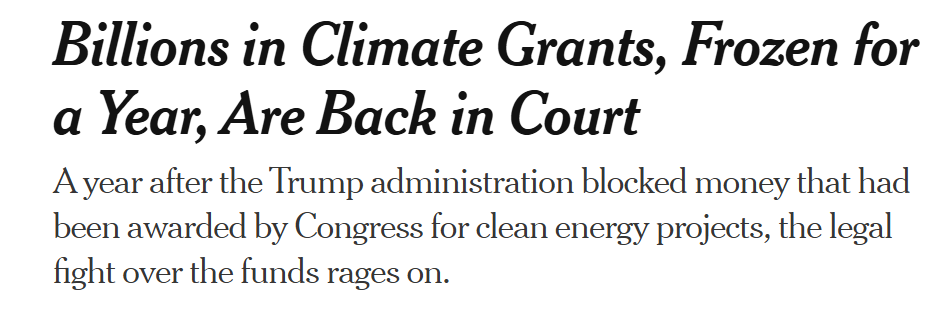
The abrupt elimination of hard-earned grant awards leaves a wake of lawsuits and recriminations, weakening the web of public partnerships that climate resilience and emergency preparedness depend on.
Source: NY Times, 24 February, 2026
Since his first days in office, the Trump administration has unlawfully withheld congressionally-mandated funds. Terminating these grant programs caused widespread harm and disruption to on-the-ground projects that reduce pollution, increase community climate resilience and build community capacity to tackle environmental harms.
— Hana Vizcarra, senior attorney at Earthjustice (SF.gov News)
4. More Local Impacts of Federal Cuts
Headlines about cancelled EPA grants and cutbacks to EPA grant programs are only part of the larger picture. Here are a few examples of other local impacts from the federal retreat from climate action and cutbacks to agencies like NOAA, the EPA, and FEMA:
Cuts to grants for local flood, wildfire, and sea level-rise forecasting
In 2025, the Trump administration began pulling back federal funding that Bay Area communities depend on to understand floods, wildfires, and sea level rise. This includes cuts and shutdowns targeting climate‑science grants at research institutions, as well as moves that could pull critical ocean and weather instruments out of the waters off our coast.

In April 2025, the SF Chronicle reported that the Central and Northern California Ocean Observing System (CenCOOS), which relies on some $3M in annual funding from NOAA, is one of the local programs at risk. CenCOOS manages instruments that monitor winds, water levels, ocean currents, heat and other data critical for business, forecasts, and safety.
Alex Harper, deputy director of the Central and Northern California Ocean Observing System, told Chronicle reporters: “It’s confusing that this work is slated for elimination when it so clearly aligns with many of the administration’s priorities around commerce, shipping, trade and national security” (“Surprise atmospheric rivers, toxic seafood: How NOAA cuts could impact California,” SF Chronicle, 25 April, 2025).
Cuts to the National Science Foundation
Federal cuts to the National Science Foundation disrupted more than 100 climate‑related research grants, including about $4Mil million for a climate fellowship program at UC Irvine focused on Earth science and environmental justice research.
Pulling this funding mid‑stream disrupts training for the next generation of scientists working with California communities on issues like heat, sea‑level rise, and air quality. (“The Trump administration has shut down more than 100 climate studies,”The MIT Review, 2 June, 2025).
Cuts to NOAA
Scientists interviewed by the Los Angeles Times warn that NOAA workforce and budget cuts could have “fatal consequences” for California by degrading fire‑season outlooks, atmospheric river forecasts, and high‑wind warnings just as climate change is likely to result in more extreme storms and fires ( “'Forecast risk': How Trump's cuts to weather experts could imperil California,” LA Times, 16 July, 2025).
5. Cuts to FEMA Undermine Local Emergency Response Resources
FEMA supports a wide range of activities that shape how well communities are positioned to handle climate-related emergencies. These include:
hazard mitigation planning
preparedness grants
technical assistance to state and local emergency managers
coordination across agencies responsible for transportation, housing, utilities, and public health
Resource and staffing gaps and delays to project and risk assessments can erode capacity, create a trust gap between the agency and the public, and curtail emergency response and readiness.
The National Weather Service continues to issue life-saving forecasts and warnings, but longer-term climate research and upgrades to forecasting tools have been suspended — at a time when California faces growing weather extremes. With vital administrative and planning staff sidelined, the state’s progress on prevention will be delayed making our state more vulnerable.
— Governor Gavin Newsom (“Trump’s shutdown leaves California disaster readiness in jeopardy,” Press release, October, 2025)
Over time, reduced federal capacity also means that local agencies come to bear more responsibility.
As these shifts unfold, larger jurisdictions may be able to compensate, at least temporarily, but resource constraints often raise the stakes for smaller cities and counties, leaving them without a plan B as federal resources vanish.
Here in the Bay Area, after the Trump administration acted to shift more emergency response responsibilities to state governments, local officials voiced concerns about state-level resources.
Mary Ellen Carroll, executive director of the San Francisco Department of Emergency Management, told reporters “"I think it would be impossible for any jurisdiction, city or county, to be able to have the amount of resources you would need” for these kinds of response efforts (“FEMA cuts could hurt an already fragile disaster response in California,” Axios, 17 March, 2025).

Federal, state, and local Emergency Response Coordination
Contra Costa County in California has opened a new Emergency Operations Center (EOC) featuring a state-of-the-art Situation Room equipped with the latest real-time visualization technology. The EOC serves as a command center in the event of a crisis or natural disaster. Its role is to improve emergency response, including the mobilization of municipal, county, and private resources.
Local Impacts of FEMA Cutbacks: A Snapshot
Greater Bay Area
A 2025 SPUR analysis reports that the Trump administration “chokes off FEMA funding,” with more than 270 million dollars in federal money for Bay Area resilience and adaptation projects simply “evaporating.”
The same analysis notes that FEMA canceled its Flood Mitigation Assistance (FMA) grantfor 2025 and has fired or otherwise lost about one‑third of its full‑time workforce since January 2025, straining its capacity to distribute funds and support local governments.
The 2025 SPUR article also noted that even before these cuts, many Bay Area jurisdictions struggled to meet the 25 percent local‑match requirement for FEMA grants, meaning that reduced federal support and slower approvals disproportionately undermine preparedness in smaller or lower‑income communities.
SF, Oakland-Alameda, Menlo Park, Napa and Sonoma
FEMA’s BRIC hazard‑mitigation program was canceled, leaving roughly 870 million dollars in California BRIC‑funded projects in limbo.
The losses include at least 270 million dollars in Bay Area projects.
Here are some of the local initiatives affected by FEMA cutbacks:
San Francisco’s Downtown Coastal Resilience Project
the Oakland‑Alameda Adaptation Project
SAFER Bay in Menlo Park
wildfire‑resilience investments in Napa and Sonoma
Pacifica’s Beach Boulevard Resiliency Project.
💡 Did You Know?
BRIC stands for Building Resilient Infrastructure and Communities, a FEMA-directed federal grant program utilized by local agencies for risk management, such as climate change adaptation, natural disaster resilience, and related risk management.
San Jose
SPUR notes that FEMA’s Hazard Mitigation Grant Program has not been officially canceled but that the Trump administration stopped approving new allocations in early April 2025, putting on hold a $25 million seismic retrofit program for soft‑story multifamily housing in San Jose.
California Task Force 3:
A Case Study in Federal Cuts and Local Impacts
One prominent example of the potential local impacts of federal cuts involves funding for critical first responders.
In particular, federal cuts to FEMA have led to the downsizing of uniquely trained Bay Area search and rescue team members, such as though operating as California Task Force 3, based in the south SF peninsula.
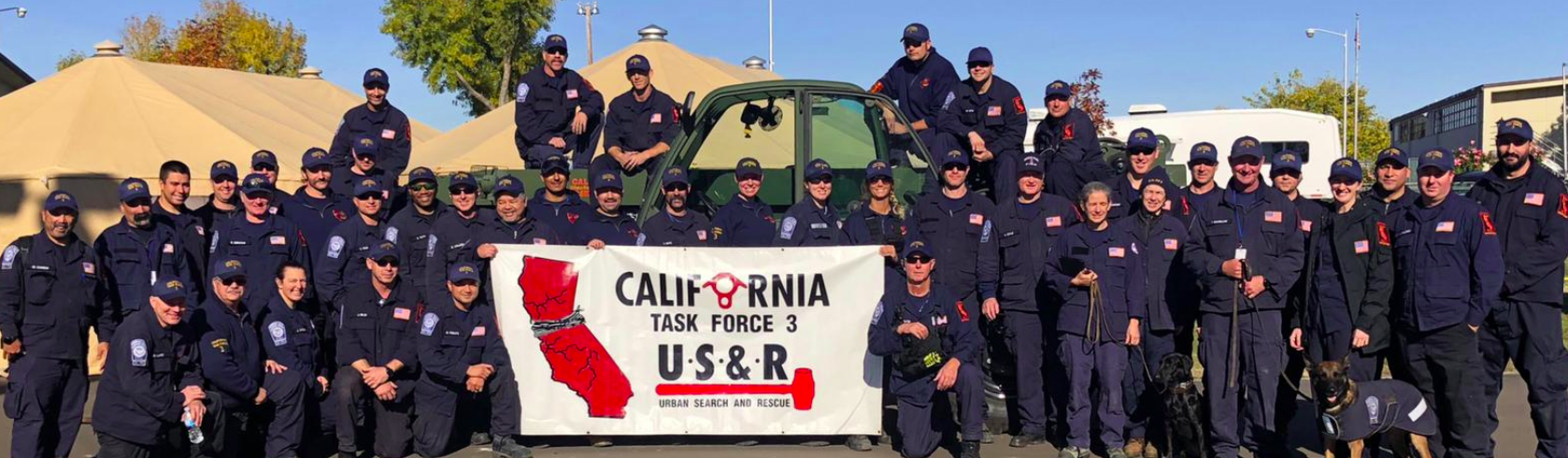
Source: CA Task Force 3
In our prior post, The Climate Safety Net: How Federal Climate Systems Quietly Support Local Resilience, we discussed how public safety infrastructure often involves many interagency funding streams and collaborations. California Task Force 3 offers a vivid example.
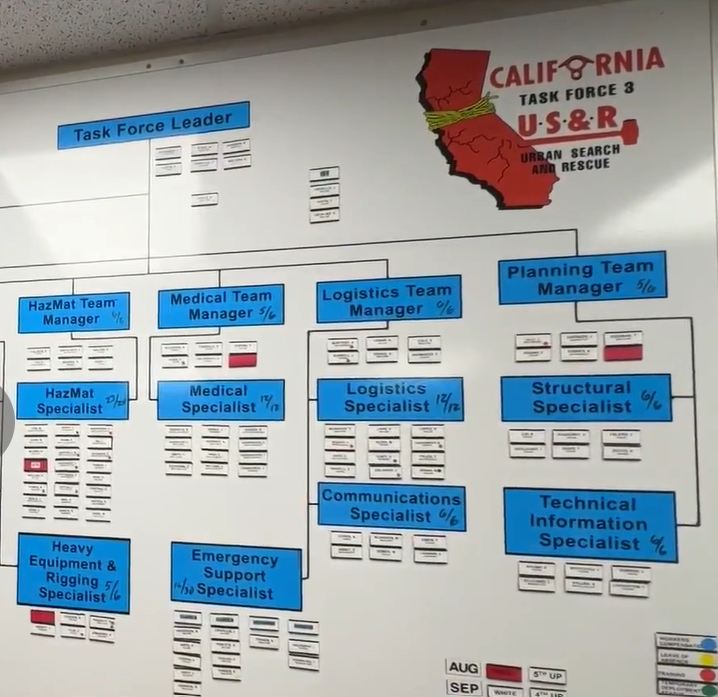
About CA Task Force 3…
CA Search and Rescue Task Force 3 is one of twenty-eight federal-level first responder teams, and one of eight California urban search and rescue teams, teams first established back in 1990.
CA Task Force 3 is based out of East Palo Alto and is sponsored by the Menlo Park Fire Protection District, in a partnership with the CA Office of Emergency Services (Cal-OES), and under contract with FEMA.
Since 1990, this team has been at work responding to both local and national emergencies, including floods, fires, extreme weather events, earthquakes, terrorist attacks, emergencies involving explosives, and more…
Cutbacks to FEMA have left officials concerned about staffing at Task Force 3: “The amount of money we receive from the federal government isn’t adequate for what is needed to maintain the teams,” said John Wurdinger, Battalion Chief with Menlo Park Fire Protection District and Program Manager for the Task Force 3 Special Operations Team.
Recently the Government Accountability Office sounded the alarm on FEMA’s ability to respond to multiple disasters as a result of the agency’s severe understaffing.
6. State & Local Resources — Are They Enough?
With a strong push to cut federal funding across a range of climate agencies and initiatives, local governments typically end up leaning into their own local efforts, seeking to pick up the slack.
The good news here is that California has made some significant investments in climate resilience, including:
California Climate Investments (funded through cap-and-trade auction proceeds) — to support air quality monitoring, emissions reduction, and community resilience programs across the state
The California Governor's Office of Emergency Services (Cal OES), to coordinate statewide disaster response and administer federal disaster funding
The California Natural Resources Agency (CNRA) — to oversee statewide climate adaptation strategy, wildfire resilience programs, coastal protection efforts, and flood risk planning
The California Ocean Protection Council and the Central and Northern California Ocean Observing System (CeNCOOS) — to support coastal and ocean monitoring, buoy maintenance, and sea-level rise data when federal NOAA capacity is reduced.
The San Francisco Bay Conservation and Development Commission (BCDC) — to lead regional sea-level rise adaptation planning and shoreline resilience efforts in the Bay Area.
However, while these programs represent serious and sustained state-level commitments, state efforts still operate at a smaller scale than federal ones when it comes to forecasting systems, nationwide research infrastructure, and large-scale disaster funding.'
As federal support fades, state and local agencies face increasing pressure to stretch limited resources further — a shift that weakens both long-term climate resilience and emergency readiness.
7. What’s Next and Who’s Fighting Back?
Coalitions of nonprofits, attorneys general, and climate advocacy groups across the US are fighting legal battles to claw back frozen and rescinded grant awards made under binding federal contracts. For most of a year now, as the New York Times recently reported, these battles have been bogged down in legal maneuvering and questions of judicial jurisdiction.
Locally, for example, the SF City Attorney, and the City and County of SF have joined a coalition of Tribes, other local governments, and nonprofits to challenge the legality of the grant cancellations — in this case focusing on the termination of the EPA’s Environmental and Climate Justice (ECJ) Grant Program despite a Congressional directive to fund them (Press Release, SF.Gov, 3 July, 2025).
Similar coalitions are challenging billions of dollars in frozen grants under the Biden-era EPA Greenhouse Gas Reduction Fund. According to reporting in the NY Times, EPA Administrator Zeldin initially suggested fraud accusations were behind the decision to freeze the grant funds, but has since “backed away from that claim in legal briefs.”
The NY Times also reported that Republican attorneys general from 24 states have filed a brief supporting the grant cancellations while forty members of congress filed a brief supporting the nonprofits.
Here are some organizations seeking to win back EPA funding for local climate initiatives or involved in securing grants for local projects:
Also, don’t forget we’ve provided links throughout this article to will connect you with organizations in the Bay Area leading local climate resilience and climate action efforts — organizations that also need renewed support, especially in the wake of cancelled grants.
Final Thoughts
The tragic loss of life in southern Texas in 2025 was a stark reminder that while extreme weather events may be inevitable, the scale of their impact is shaped in part by human decision making, including political and spending priorities.
The examples highlighted in this post — rescinded resilience grants, delayed hazard mitigation programs, strained emergency response resources, and reduced monitoring capacity — demonstrate how federal decisions have consequences for public safety here at home and for the larger global effort to reverse global warming.
As the Trump administration and legislative majorities retreat from funding climate agencies and climate research, local communities are being left to navigate growing climate risks with fewer tools and less federal support.
How can we respond? Knowing how to focus our action can help. Below are some key takeaways to guide climate activists.
Key Takeaways
Preparedness reduces harm. While extreme weather cannot be prevented, sustained investment in early warning systems, hazard mitigation, research, and emergency coordination can significantly reduce loss of life and mitigate the scale of disruption.
Federal funding decisions have real local consequences. From cancelled grants and staff cutbacks to reduced monitoring capacity, federal cuts to climate agencies and initiatives have tangible impacts on local Bay Area communities, making it harder for Bay Area communities to anticipate and manage climate risks.
State and regional agencies are stepping up — but they cannot fully replace federal scale. California has made substantial climate investments, yet nationwide research networks and disaster funding systems operate at a level that states alone cannot replicate.
Preparedness gaps are not always visible. Slower reimbursements, thinner monitoring networks, and stretched emergency teams may go unnoticed — for a time — but the gaps in overlapping resilience efforts can have significant consequences when disasters strike.
Public safety is influenced by civic choices. Budget priorities, public awareness, and local engagement can play a powerful role in helping local communities maintain preparedness planning and resources.
Understanding these dynamics can help all of us better see the current climate landscape as we vote, organize, lobby, and mobilize.
What You Can Do

Core actions to consider now:
Follow Climate Reality Bay Area — our newsletter and social channels make it easy to stay engaged, get connected, and know about upcoming events and actions
Share this post — with neighbors, parent groups, community organizations, and local leaders. (Sign up here.)
If you or someone you know has been directly impacted by federal cuts to climate agencies and initiatives, please share your story in the comments section below.
Join a Climate Reality Bay Area Policy Action Squad or connect with any other CRBA team that’s a fit for your interests and aptitudes.
Additional CRBA teams include:
community engagement
climate justice
green schools
communications
fundraising
events
and more…
However you connect, you’ll make a bigger impact by joining your efforts to those of other Bay Area residents just like you — all looking for ways to make a difference.
More Resources…
You’ll also find links to organizations, resources, and action tips at the end of the other blog posts in this series.
Haven’t seen those articles yet?
Be sure to check them out to get a full picture of the potential impacts of federal cuts on Bay Area communities:
Water Frontlines: How Federal Cuts May Increase Flood and Sea Level Risks in the Bay Area
The Climate Safety Net: How Federal Climate Systems Quietly Support Local Resilience
Click Below To Get Connected, Build Community, and Make a Difference!
To learn more about the federal retreat from climate action and about other climate topics and resources, check out other posts in this series:
Part 1: Mapping the Federal Retreat From Climate Action (Overview)
Part 3: Water Frontlines: How Federal Cuts May Increase Flood and Sea Level Risks in the Bay Area
Part 4: The Climate Safety Net: How Federal Climate Systems Quietly Support Local Resilience
Part 6: When Climate Change Denialism Drives Federal Policy — A Recipe for Disasters
Next in this series:
When Climate Denialism Drives Federal Climate Policy — A Recipe for Disasters
Author Bio
Keith Nickolaus is a communications professional and former educator based in Berkeley. As leader of the CRBA Writers Team, he works to amplify community voices and is passionate about informing and inspiring climate action across the Bay Area.