The Climate Safety Net: How Federal Climate Systems Quietly Support Local Resilience
Mapping the Federal Retreat From Climate Action — Part 4
By Keith Nickolaus, PhD, CRBA Writers Team
This post is the fourth in our ongoing series Mapping the Federal Retreat From Climate Action.
The series examines how recent federal cutbacks to climate science and to key agencies are reshaping environmental risks locally and how Bay Area communities can respond.
Our most recent posts focused on risks from flooding and rising sea levels, and on local wildfire threats.
This post explores the ways systems that protect public safety rely on coordination between interdependent agencies — systems that translate climate science, forecasting, and funding into real-world preparedness and response. This is why deep federal cuts to key agencies such as NOAA, the EPA, FEMA, and to climate science research can compromise public safety — with the risks often hidden from public view until it’s too late.
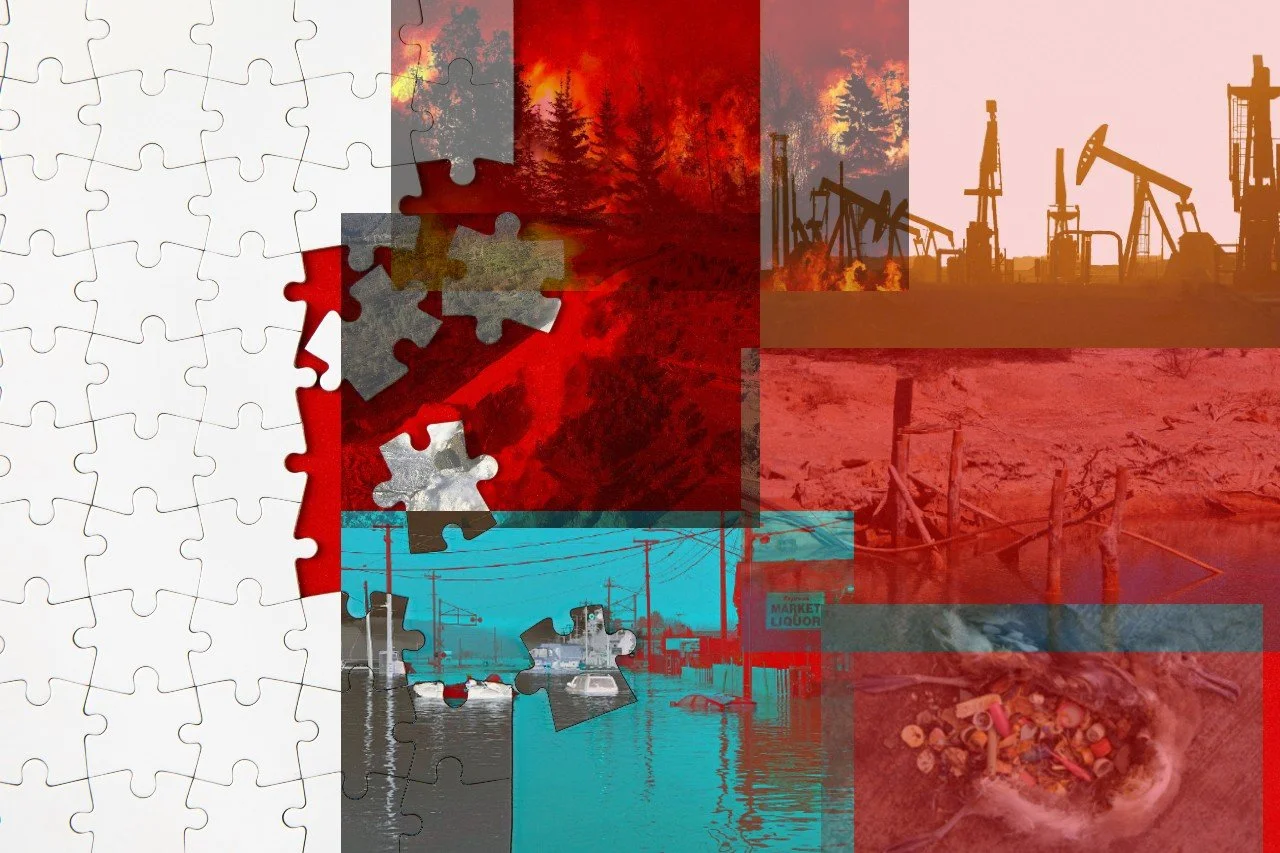
Overview: The Potential Local Impacts of Federal Cuts – A Systems Perspective
In earlier posts in this series, we looked at climate risks that are growing more frequent across the Bay Area — wildfire danger shaped by changing weather patterns, and water-related risks — tied to flooding, storms, and sea level rise. These are risks people can often see, measure, and experience first hand in their own communities.
This post focuses on a different layer of impact: the systems that help communities anticipate climate-related hazards, plan for them, and respond when conditions change.
These include the federal agencies, data networks, funding flows, and expert capacity that quietly support local preparedness and emergency response — often without much public attention.
Unlike a wildfire or a flood, systems risk does not show up all at once but builds gradually, through staffing losses, coordination gaps, and slower, less-informed decision-making.
These are not sudden failures, but ones that over time have consequences for how well early warnings are issued, how quickly help arrives, and how effectively communities recover after an emergency.
By understanding how these systems rely on intertwined agencies and efforts — and how federal cuts to climate funding and key agencies such as NOAA, FEMA, and the EPA can impair these systems, Bay Area residents will gain a more nuanced insight into the hidden fissures that are weaking these systems, into the tangible public safety risks these cuts will entail, and how we can respond.
1. What the Federal “Safety Net” Actually Does
Discussions about federal climate cuts often focus on individual agencies or programs, agencies like NOAA, EPA, and FEMA operate less like stand-alone institutions and more like shared infrastructure.
Each agency has unique expertise and capacity to contribute and distinct roles to play in ensuring robust technical support, manpower, and coordination for national and local resilience planning, for weather forecasting, climate modeling, and emergency response efforts.
NOAA’s Role
Local residents rely on NOAA for more than daily weather forecasts. NOAA scientists and technicians maintain long-term monitoring systems, collect climate and ocean data, and develop models that help local agencies anticipate floods, storms, wildfire conditions, and coastal impacts.
Much of this work happens continuously and quietly — and not just thanks to federal efforts, but global ones. As Bay Area resident Tom Murphree, a scientist specializing in Atmospheric Sciences, told me, local weather and climate projections are informed by models, data-sharing networks, collaborations, and inter-agency agreements that span the globe.
These data networks help guide emergency response preparedness efforts and inform long-range decision-making for resilience planning — such as helping civic planners know which waterfront communities or infrastructures are most vulnerable, or when firefighting teams need to be ready for unseasonably warm and dry years.
The Role of the EPA
The EPA plays a different but complementary role. In addition to setting and enforcing environmental standards, the agency helps translate scientific research into usable tools for risk assessment, planning, and public health protection.
EPA staff also manage grants that fund local resilience projects, convene agencies across jurisdictions while providing them technical support, and help identify environmental risks that may not yet be visible to the public.
This convening and technical role is especially important in densely populated and geographically complex regions like the Bay Area, where environmental, infrastructure, and population vulnerabilities overlap.
FEMA
Many people rightfully associate FEMA with disaster response and relief roles. What’s less visible is that FEMA also supports local initiatives through support for hazard mitigation planning, preparedness grants, technical assistance, and inter-agency coordination — among federal, state, and local emergency managers. These functions help communities reduce risk in advance and ensure greater workforce readiness and resource allocation when disasters do occur.
As the graphic below illustrates, emergency response systems involve a web of inter-related agencies, jurisdictions, and alert systems — highlighting the way that cuts to any single agency can have a domino effect that results in resource gaps, communication lapses, and system fragmentation.
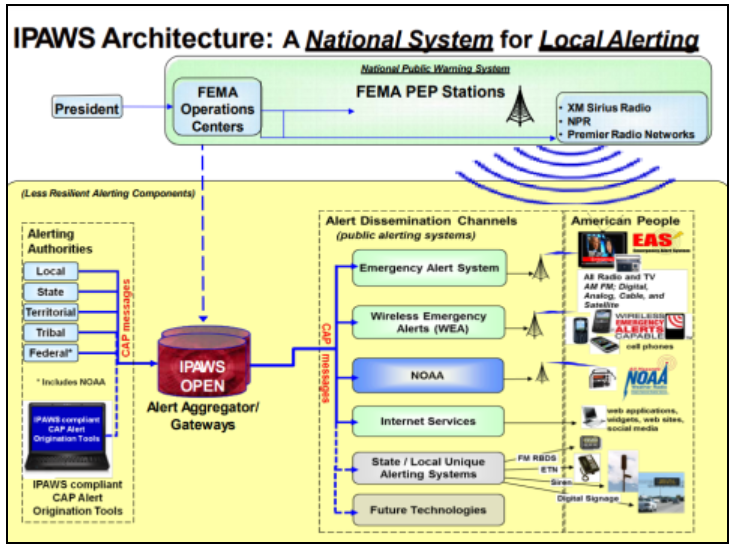
Source: FEMA, The Integrated Public Alert and Warning System: IPAWS 101, 2017, p. 9, https://www.tn.gov/content/dam/tn/tema/documents/IPAWS_101_Presentation_04212017.pdf.
Notes: CAP = Common Alerting Protocol; EAS = Emergency Alert System; IPAWS-OPEN = Integrated Public Alert and Warning System Open Platform for Emergency Networks; NOAA = National Oceanic and Atmospheric Administration; PEP = primary entry point.
Putting the Pieces Together…
Put the contributions of all three agencies together — NOAA, the EPA, and FEMA — and it’s easy to see the high level of interdependence and coordination:
climate data feeds into planning models
planning informs mitigation and preparedness
preparedness shapes response and recovery
When appropriately funded, this federal safetynet allows local governments to operate with reliable information, clearer coordination, and data-driven decision making — even though much of that support remains hidden from public view.
As Bay Area scientist Lisa Micheli pointed out after the devastating flood in south Texas in July 2025 that resulted in more than two dozen deaths, saving lives almost always requires all the parts working together:
Despite the local weather service staff being down an estimated 20%-40% relative to last year, they still managed to get this critical forecast out the door with days to prepare for the deluge. However, the challenge of communicating data-driven situational awareness to those most vulnerable is having sufficient federal and/or state technical personnel to support local jurisdictions in a coordinated response (“Close to Home: Science is not just a ‘nice to have’,” The Press Democrat, 16 Feb, 2026).
This system perspective highlights why resilience planning and emergency response efforts are vulnerable, especially at a time when federal cuts are impacting not just one, but several key agencies.
The CRBA Writers Team pledges to share climate truths you can trust — not noise.
Sharing information grounded in facts, science, reputable media, and cited openly, our work cuts through disinformation to empower our community toward climate action and justice.
Interagency Coordination: The Example of AQPI
The Advanced Quantitative Precipitation Information System (AQPI) offers a compelling case study of climate data systems and their reliance on a multifaceted fabric of interagency participation and coordination.
What is AQPI and why does it matter for the Bay Area?
AQPI uses enhanced weather radar to track atmospheric rivers.
AQPI data is complemented by other data streams, from Forecast Informed Reservoir Operations (FIRO)and the Atmospheric Rivers (AR) Portal and AR observation network, for example.
AQPI has been implemented to improve forecasting that will help flood agencies, emergency responders, wastewater plant managers, reservoir operators, and water managers respond to extreme weather events in a timely fashion (“AQPI — Bay Area Water Agencies Working Together,” Sonoma Water, accessed 12 Feb, 2026).
The Advanced Quantitative Precipitation Information (AQPI) project, based in the San Francisco Bay Area, enhances weather radar data, surface measurements, and forecasting for better short-term precipitation predictions. Improved monitoring boosts public safety by enhancing early warnings and storm tracking, especially for atmospheric rivers, including their cascading impacts such as flooding, landslides, and debris flows.
— PSL Advance (PSL Newsletter, March 2025)
What kind of interagency coordination goes on behind the scenes?
AQPI efforts rely heavily on an extensive network of Bay Area agencies to help inform SF Bay Area water management strategies. In short, there’s lots of interagency coordination going on behind the scenes:
AQPI was funded in 2016 by a grant from the California Department of Water Resources (DWR) Integrated Regional Water Management Program (IRWM) awarded to Sonoma Water and participating Bay Area agencies.
The SF Bay AQPI framework for regional collaboration is developed by A Local Partner Agency Committee (LPAC).
Radar for data collection relies on a network of local agencies and public utility companies (PSL Advance, PSL Newsletter, March 2025).
The University of California San Diego, Scripps Institution of Oceanography, Center for Western Weather and Water Extremes (CW3E) are assisting the LPAC member agencies in developing an operations and transition plan for the AQPI system (“AQPI — Bay Area Water Agencies Working Together,” Sonoma Water, accessed 12 Feb, 2026).
The regional effort is backed by federal agencies — including NOAA, NOAA’s Physical Science Laboratory, and the Cooperative Institute for Research in the Atmosphere (CIRA). Cira, in turn, relies on a premier research partnership between NOAA and Colorado State University (in Fort Collins, Colorado).
Improved precipitation monitoring and prediction in the San Francisco Bay region can enhance public safety through early warning and storm tracking when hazardous weather events come onshore.
— NOAA Physical Sciences Laboratory “About” Page (accessed 12 Feb, 2026)
While all of this collaboration is good news for planning, warning systems, and enhanced public safety in the event of storms, any steep cuts to NOAA could create systemic gaps.
Trump‑era cuts to NOAA, of about 1.7 billion dollars, are expected to “hamper weather forecasting, disrupt critical ocean data collection and decimate climate research,” and could force the Central and Northern California Ocean Observing System (CeNCOOS) to pull ocean instruments off the Bay Area coast (“Surprise atmospheric rivers, toxic seafood: How NOAA cuts could impact California,” SF Chronicle, 25 April, 2025).
NOAA lost about 30 percent of its funding in 2025 and is set to spend roughly 14 percent less on climate research than Congress directed, including funding for climate labs, cooperative institutes, and regional data programs that feed directly into wildfire‑risk assessments and flood forecasts for Northern California (“The Potential Impact of NOAA Budget Cuts on Commercial Real Estate,”Urban Land, Sept. 2025).
2. The Quiet Erosion of Federal Capacity
Once the role of federal climate and emergency agencies is understood, the nature of the risk becomes clearer. At agencies such as NOAA, EPA, and FEMA, much of the work that supports local preparedness and response depends on the deep expertise of career staff who have built regional knowledge over decades. These staff understand how datasets connect, how grants move from approval to implementation, and how agencies coordinate during both planning phases and emergencies.
However, because much of this work happens upstream, the effects are not immediately visible.
For example, Bay Area resident and retired EPA scientist Emily Pimentel said people often don’t realize that interdependent networks of agencies and organizations are also relying on this kind of data. And, it’s all of these different organizations — together with reliable data streams — that create a foundation for effective action and planning. Pimentel told me that EPA scientists often played an important role alongside various local jurisdictions, committees, and agencies to help ensure land-use and environmental planning efforts included robust technical guidance and robust community input.
One of the things that I would want your audience to understand is that EPA did not do so-called DEI work. We look at risks and those risks are mapped so that we know where to work, what questions to ask, which communities are most vulnerable… We look at economic data. We look at, you know, socioeconomic conditions. We look at vulnerabilities where children are, where elderly are… And that's the kind of data that is, you know, being denied now too.
— Emily Pimentel, retired EPA scientist
Emily Pimentel holds a BS in Chemistry and Biology (University of Texas, Austin) and a MS in Marine Ecology (SFSU). Pimentel, who now lives in the Bay Area, worked in the private sector as an Environmental Engineering Specialist and Consultant for over 20 years, and worked with the EPA for 21 years — before retiring in April 2025.
During Trump’s second term, his administration has shown scant regard for this kind of capacity at the EPA. In fact, the administration announced plans to do away with the EPA’s ORD (Office of Research and Development) — the EPA’s primary scientific research arm. ORD has been so consequential in helping establish better regulatory safeguards, that it’s hard to overstate how the effort to eliminate it and restructure the EPA could affect public safety in the years to come. The following section takes a closer look at what this all means.
3. 2025: The Advent of Trump’s “New” EPA
In an internal EPA memo obtained by POLITICO’s E&E News, [EPA Chief Administrator] Lee Zeldin told staffers that the agency is ushering in a ‘new, more efficient, more effective EPA’ that focuses on meeting statutory obligations. He said the revamp follows a six-month review by the agency’s leadership. In the note to staff [Zeldin] declared that ‘today is day one of the new EPA,’ and the first part of a transition period that will play out through the end of November.
— “EPA reorganization sparks fears of ‘political interference’,”Politico (E&E News) 22 Sept, 2026
As the EPA restructuring unfolds, it’s reported that it will entail an overall 23% EPA staff reduction (approximately 3,700 jobs), and a potential cutback of “as many as 1,155 EPA chemists, biologists, toxicologists, and other scientists…” (“EPA Eliminates Office of Research and Development, Will Cut Over 3,700 Staff,” Sabin Center for Climate Change Law, Columbia Law School, accessed 21 Feb, 2026).
EPA administrator Zeldin said the restructuring would include the creation of a new Office of Applied Science and Environmental Solutions (OASES) that would, according to EPA officials cited by NPR, “allow EPA to prioritize research and science more than ever before and put it at the forefront of rulemakings and technical assistance to states.”
In his own announcement, Zeldin said: “We are bolstering scientific capacity where it matters most — directly in our air, water, and land program offices — so that EPA scientists can better-support EPA’s core mission and statutory obligations.”
An Incredible Loss of Time-Tested Expertise and Independence
While Zeldin’s announcement pointed to a new science unit to replace ORD, the shift has been viewed skeptically among many leading scientists and some political leaders.
One key concern is the decision itself. Afterall, the EPA is an agency that’s proven highly effective, by many metrics, since its founding in 1970 — a time when industrial pollutants were posing severe and growing threats to human health and to the environment.
Here’s how reporters with the Journal Science described ORD, before listing an impressive resume of achievements (read more here):
For more than five decades, the ORD has provided the best available science on a range of issues, including toxic chemicals and pollutants in the air, water, and soil. Some of its work has flown in the face of controversies, yet has stood the test of time.
Advocates with the National Resources Defense Councilhave noted that since the EPA’s founding, concentrations of common air pollutants like sulfur dioxide have dropped by as much as 78 percent, and the agency has helped mitigate crises such as acid rain, leaded gasoline, and DDT.
They argue that the EPA’s success has nearly erased public memory of how contaminated the environment was in the 1960s, when support for creating the EPA and passing major environmental laws was virtually unanimous.
Even when the EPA was fully funded, said retired Bay Area EPA scientist Eugenia McNaughton (PhD in Biology and career Quality Assurance Specialist with the EPA), there were not enough resources to keep up with the polluters:
Back in the 1990s and before, all kinds of regulations were coming out — for air, water, soil — and we had to figure out how to test all these for toxins. This included air quality, water quality, and then soil, superfund sites, etc.… All this time the big bad boys [industry polluters]were still doing their thing… and the EPA never had realistic funding to do this huge amount of work, even then, nor were we alone, there were other agencies doing essential auxiliary work as well.
EPA Cutbacks Trigger Alarm Bells From Scientists, Unions, and Lawmakers
Robert Kavlock, a retired EPA scientist who also founded the EPA’s center for computational toxicology, called the staff cuts and retirements impacting the EPA in 2025 “an incredible loss of expertise.”
According to the Journal Science, ORD was crucial to global and local efforts to understand how climate change affects air quality, ecosystems, water quality, community resilience, and potential threats posed by wildfires, heat, floods, and drought. In addition, ORD produced research to help local jurisdictions and Tribes that lacked the necessary resources and expertise to conduct research.
Union president Justin Chen, with the American Federation of Government Employees Council 238, called ORD “the heart and brain of the EPA,” and said that “without it, we don’t have the means to assess impacts upon human health and the environment. Its destruction will devastate public health in our country.”
Zoe Lofgren, ranking member of the House Science, Space, and Technology Committee, said that “the obliteration of ORD will have generational impacts on Americans’ health and safety.”
A group of bipartisan senatorssignaled strong opposition to the proposal to close ORD, with Politico noting “The Agency has touted savings in direct Federal spending, but fails to acknowledge the immeasurable risk to our health and environment…”
Scientists also worry about the impact of dispersing ORD functions across regulatory offices, effectively “siloing” research efforts and impacts.
Zoe Lofgren, ranking member of the House Science, Space, and Technology Committee, said that ‘the obliteration of ORD will have generational impacts on Americans’ health and safety.’
Breaking Bonds of Trust: Putting Politics Before Science
Another concern about EPA cutbacks and restructuring involves the public’s right to independent scientific research and information sharing and the importance of keeping publicly funded research as free as possible from political interference or coercion.

OASES, the EPA agency replacing ORD, is slated to be housed within the Office of the new Trump-appointed EPA Administrator.
This shift may sound purely bureaucratic on the surface, but critics fear the move is intended to compromise researchers’ independence and deprive OASES of the kind of fact-driven independence that puts the public interest before partisan political interests and the interests of big business.
ORD, unlike the new OASES, was intentionally designed to be free from EPA’s policy-making offices and be kept out from under the EPA’s administrator — in order “to protect its scientists from direct managerial or political interference” (“The EPA’s shaken foundation,” Editorial in the Journal Science, 25 Sept, 2025).
The move to eliminate ORD is part of the Trump administration’s war on science. EPA Administrator Lee Zeldin is laying off and forcing out scientists in record numbers, and slashing research and travel budgets for the remaining EPA scientists. With ORD eliminated, those who remain will work in policy offices or under the administrator. One reason ORD has been a separate office since 1970 was to protect its scientific work from policy-oriented biases and political interference.
— Tim Whitehouse, Executive Director of Public Employees for Environmental Responsibility, Jul 21, 2025 Press Release
For decades, environmental research on chemicals, air pollutants, and climate change has often put regulators at odds with industry groups seeking fewer restrictions. Thomas Burke, an epidemiologist at Johns Hopkins University and former EPA science adviser, described the shuttering of ORD as a political power play — “a total victory for the polluters.”
Unions are also among the groups who fear what the EPA restructuring will mean for researchers’ freedom and independence:
They are putting [OASES] directly under the administrator and subjecting it to political interference, subjecting research at the office to political interference.
— Nicole Cantello, president of American Federation of Government Employees Local 704 representing EPA Region 5 employees (cited in “EPA reorganization sparks fears of ‘political interference’,” Politico, 22 Sept, 2026)
Final Thoughts
Federal agencies such as NOAA, EPA, and FEMA do more than carry out individual programs. They help align climate science, planning assumptions, funding mechanisms, and emergency operations across levels of government. When capacity erodes across multiple agencies at once fragmentation results in resource gaps, weaker communication channels, and limited coordination.
Forecasts may still be issued, grant programs referred to in name, and some essential emergency response structures may still function, but behind the scenes, fewer people are available to maintain monitoring systems, interpret complex models, process grants, or serve as points of coordination between federal, state, and local partners. Science may also be more easily corralled by political heads, in order to curtail regulatory safeguards for corporate interests.
This kind of capacity erosion can gradually undermine or thwart efforts focused on climate resilience, weather and disaster forecasting, and emergency response capacity. Over time, these multiplying gaps can jeopardize public safety, especially in the wake of a major event, threat, or crisis.
However, the Bay Area climate community is large, informed, and vocal. Understanding how these systems work — and recognizing the hidden impacts and risks cutbacks can impose — can help us to respond thoughtfully, advocate effectively for better policy, and look for local solutions.
Understanding how these systems work — and recognizing the hidden impacts and risks cutbacks can impose — can help us to respond thoughtfully, advocate effectively for better policy, and look for local solutions.
Key Takeaways
Federal climate agencies operate as shared infrastructure.
NOAA, the EPA, and FEMA do more than run individual programs — they form an interconnected safety net that supports forecasting, planning, mitigation, and emergency response across jurisdictions.Resilience depends on coordination, not just funding.
Data collection, research, grant administration, hazard mitigation planning, and emergency response are interdependent. When staffing and institutional capacity decline across multiple agencies at once, fragmentation can replace coordination.The dismantling of the EPA’s Office of Research and Development (ORD) represents a structural shift.
ORD has long served as the EPA’s independent scientific engine — informing air quality standards, toxicology assessments, climate modeling, and local risk mapping. By eliminating ORD, the Trump administration is weaking the federal research foundation that local decision-making depends on and public trust in the EPA as a source of fact-based research insulated from political interference may also falter.Systems risk builds gradually and often invisibly.
While specific agency cuts or reforms often make the news, the impact on larger systems of networked coordination and resource-sharing often remain hidden from public view, but can have significant consequences over time and at times of peak risk to public safety.Inequities increase.
Smaller jurisdictions and under-resourced communities are often the least able to replace lost federal expertise or absorb delays in funding and coordination, so federal cuts will often exacerbate, not alleviate, inequities.Understanding systems is part of resilience.
Public awareness of how these networks function — and how they’re impacted by federal cuts — helps communities monitor emerging gaps and engage more effectively before those gaps widen.
What You Can Do
Core actions to consider now:
Follow Climate Reality Bay Area’s newsletter and social channels for updates.
Share this post with neighbors, parent groups, community organizations, and local leaders (sign up here).
If you have been impacted by wildfire or smoke, consider sharing your story in the comments.
Support and help inform local shoreline adaptation projects (city meetings, Bay Conservation and Development Commission hearings…).
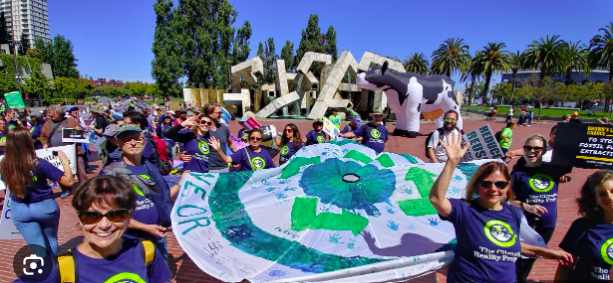
Join a Climate Reality Bay Area Policy Action Squad or connect with any other CRBA team that’s a fit for your interests.
Additional teams include:
community engagement
climate justice
green schools
communications
fundraising
events
and more…
However you connect, you’ll find a network of other Bay Area residents just like you — all looking for ways to make a difference.
Remember, you’ll also find other helpful resources and ways to engage listed in other posts in this series:
To learn more about the federal retreat from climate action and about other climate topics and resources, check out other posts in this series:
Part 1: Mapping the Federal Retreat From Climate Action (Overview)
Part 3: Water Frontlines: How Federal Cuts May Increase Flood and Sea Level Risks in the Bay Area
Part 6: When Climate Change Denialism Drives Federal Policy — A Recipe for Disasters
Click Below To Learn More About CRBA and How To Get Connected!
Author Bio
Keith Nickolaus is a communications professional and former educator based in Berkeley. As leader of the CRBA Writers Team, he works to amplify community voices and is passionate about informing and inspiring climate action across the Bay Area.