
The Limits of Carbon Capture in the Race Against Global Warming
Is carbon capture a climate solution we should get behind or is it a ploy fashioned by disinformation campaigns and designed to prolong our reliance on fossil fuels?
In this post we'll untangle fact from hype with a close look at hard evidence, detailing carbon capture's deep limitations, and sharing what’s recently been uncovered about how carbon capture made its way into climate models to begin with.
This post also serves deep-dive backgrounder for our companion post about the proposed Montezuma Carbon Capture and Sequestration Hub project — a project currently under EPA review that would severely impact the SF Bay/Delta Region for decades to come.
By Keith Nickolaus, PhD, CRBA Writers Team
Overview
Carbon capture and storage (CCS) refers to a set of technologies designed to capture carbon dioxide emissions from industrial facilities or power plants and transport the CO2 for underground storage or industrial use.
Carbon capture is touted by fossil fuel companies and by some political leaders as a technology that can play a significant role in the race to combat climate change. For many scientists, economists, and environmental advocates, however, carbon capture is believed to be at best one small piece of the puzzle for combatting dangerous levels of C02 emissions, among many other more effective and affordable solutions. But even this position is also debated. Many climate researchers and environmental advocates argue that the technology remains too expensive, too limited, too infrastructure-intensive, and too closely tied to fossil fuel expansion to play a meaningful role in solving global warming at scale.
This means it’s urgent for us to question what CCS technology promises — to highlight concerns about viability, about environmental and health risks and financial costs, and to broadcast recent revelations about the disinformation campaigns that have shaped the research and narratives promoting industrial carbon capture.
Getting the story straight is crucial — in order to advocate and mobilize with solidarity, clarity and insight so we can steer public and private investments and national and local policymakers, legislators, and regulators away from flawed solutions and toward ones that really work for all of us, before it’s too late.
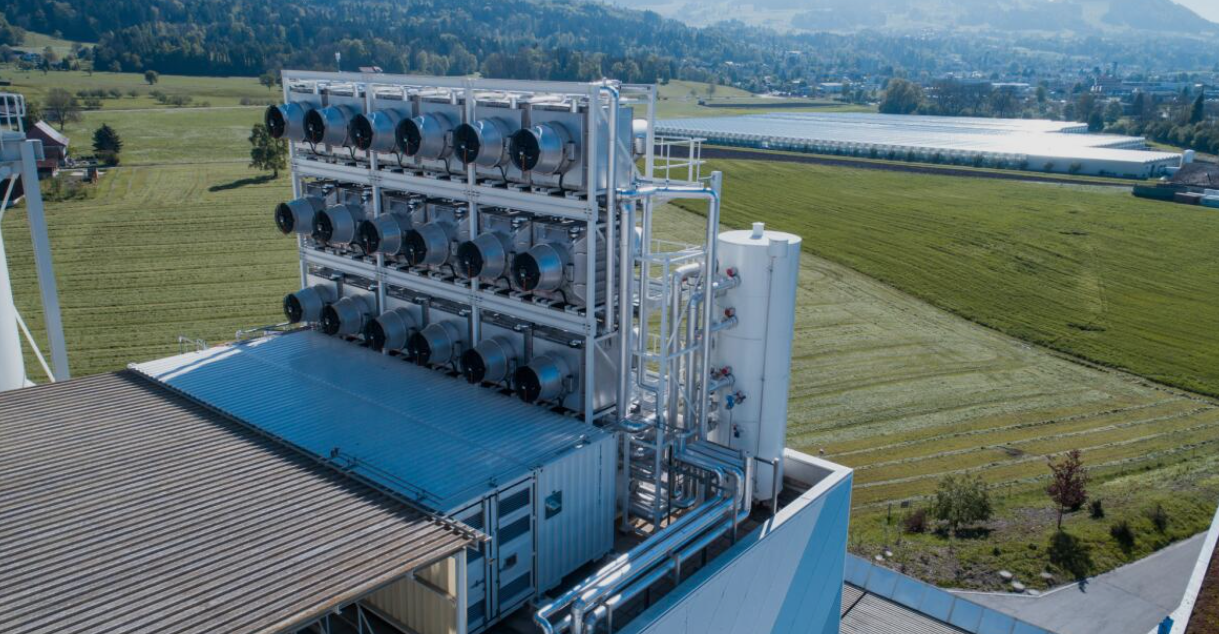
Direct Air Carbon Capture Technology (Image courtesy of the UCLA Institute of the Environment and Sustainability)
The CRBA Writers Team pledges to share climate truths you can trust — not noise.
With information grounded in facts, science, reputable media, and cited openly, our work cuts through disinformation to empower our community toward climate action and justice.
How Is Carbon Capture and Storage Supposed To Work?
Carbon capture and storage (CCS) is designed to prevent some carbon dioxide emissions from entering the atmosphere.
In simplified form, the CCS process involves three primary stages:
capturing CO2emissions at an industrial facility or power plant
transporting the emissions — usually through pipelines
storing the emissions underground in deep geological formations or using it for industrial purposes
In some variations, the captured or “sequestered” carbon dioxide, or some portion of it, may be re-used instead of stored (Carbon Capture, Utilization and Storage or CCUS).
A related technology known as Direct Air Capture (DAC) attempts to remove carbon dioxide directly from ambient air using large industrial filtration systems and chemical processes. Once captured, the carbon dioxide is compressed into a dense form for transportation and long-term storage.
One important feature of CCS is that it requires a capital-intensive industrial infrastructure and processes.
When implemented at scale this translates into significant environmental impacts and a range of biodiversity and public health risk factors.
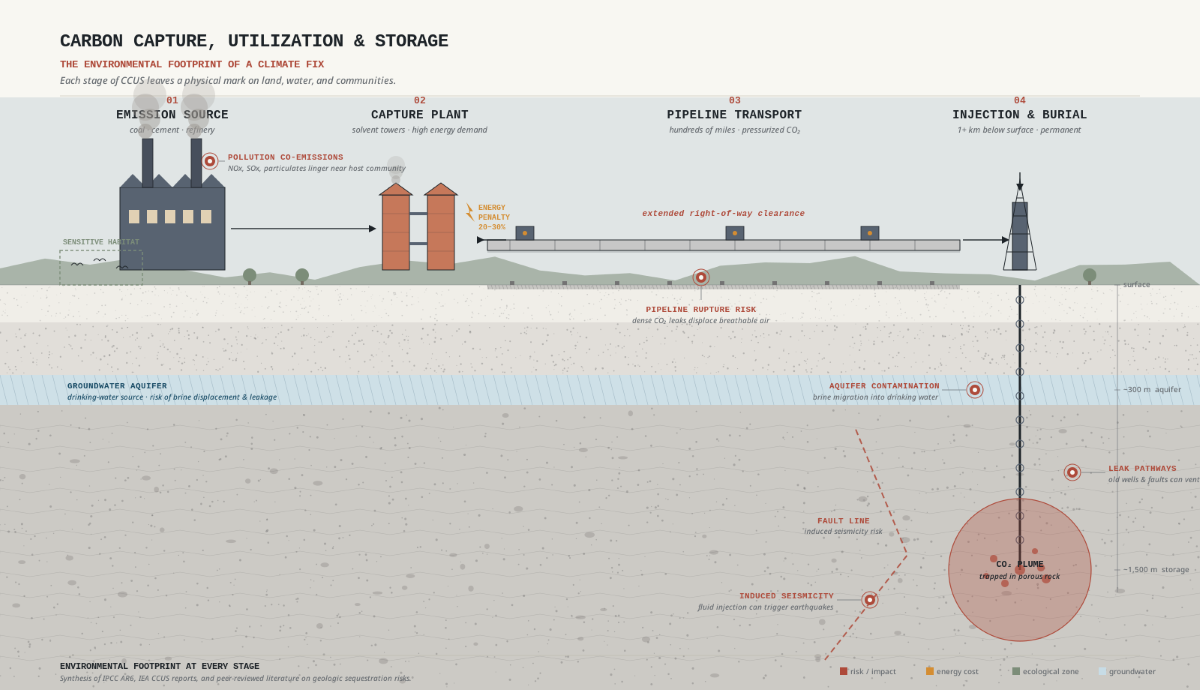
CCS in Practice: Capture, Pipelines, Storage, and Fossil Fuel Extraction
For a quick and accessible primer on carbon capture technologies in general, check out this article from the World Resources Institute: “7 Things to Know About Carbon Capture, Utilization and Sequestration.”
Will Carbon Capture Work?
Supporters of CCUS often point out that carbon capture technologies are real and operational. That is true, but only a part of the picture, and arguably misleading to say the least.
While a limited number of facilities around the world currently capture carbon dioxide emissions from industrial activities such as natural gas processing, fertilizer production, and hydrogen manufacturing, many projects are stalling.
In addition, a credible CO2 reduction strategy depends on scale — and that is where carbon capture continues to fall dramatically short.
Human activity today sends tens of billions of tons of carbon dioxide into the atmosphere every year. Existing CCS projects collectively only capture the tiniest fraction of these emissions.
Even after years of investment, subsidies, and political support, carbon capture remains marginal relative to the sheer scale of the global climate emergency.
Many projects have also failed to achieve the capture rates promised by industry advocates. Promotional claims frequently highlight theoretical capture efficiencies approaching 90% or higher, but credible sources are telling us that real-world results don’t measure up to the hype:
CCS technology has been around for decades, yet its actual, real-world implementation in either the large commercial hydrogen production sector or the utility-scale power production sector has been unreliable and far below the 90 percent to 95 percent capture rate that is considered the industry’s prime objective for CCS. Not only that, but among the projects that have been built, substantial failures have occurred. This might have been understandable in the 1970s, 1980s, and possibly even the 1990s. But the fact that the problem persists into the 2020s makes CCS a highly risky investment (Institute for Energy Economics and Financial Analysis).
And even if future projects improve technically, scaling carbon capture for any marginally meaningful impact would require an enormous new industrial buildout:
thousands of miles of CO2 pipelines
massive underground storage systems
compressor stations
monitoring infrastructure
and decades of regulatory oversight
All of this would need to happen extraordinarily quickly — at precisely the same time scientists warn the world must sharply reduce emissions within this decade.
For these reasons, many CCS skeptics argue that even if the science itself was credible, carbon capture would likely fail:
The solution is hard to scale.
The carbon reduction benefits would be woefully inadequate compared to the scale of the CO2 emissions problem.
The required investments, even for minute benefits, are enormous.
Even as the pipeline of CCUS projects grows year over year, progress remains far below what climate models indicate is needed due to stubbornly high costs, regulatory challenges, and insufficient policy and financial support.
— “7 Things to Know About Carbon Capture, Utilization and Sequestration,” World Resources Institute, 16 May, 2025
Yet, despite these obstacles, even some committed climate advocates may worry we need to keep every solution on the table given the urgency of the moment.
So we still need to dig further…
Carbon Capture: A Double-Edged Sword?
Two intersecting facets of the carbon capture narrative pose a considerable conundrum for environmentalists.
While some expert analyses suggest we can’t omit industrial forms of carbon capture from among the solutions for meeting CO2 reduction targets, many environmentalists cast doubt on the feasibility of the technology itself and its high financial and social costs.
In particular, high-level reporting from the International Panel on Climate Change (IPCC) has numerous references to climate models that rely in part on carbon capture and storage (CCS), carbon capture and use (CCU) and Direct Air Carbon Capture (DACC) technologies in the mix of solutions to be deployed in the race to reduce greenhouse gas (GHG) emissions.
At the same time, however, implementing CCS/CCU and DACC comes with exceptionally high social, financial, and environmental costs compared to many alternative clean energy-focused solutions.
While many climate models rely on at least modest contributions from carbon capture and storage solutions in the race to meet CO2 reduction targets, these technologies come with exceptionally high opportunity costs: social, financial, and environmental.
A big downside of carbon capture technology for environmentalists is that it will result in the build out of a new layer of industrial infrastructure that comes with many of the harms inflicted by our existing oil drilling and coal mining activities, from fossil fuel refineries, and fossil fuel power generation.
Also of little consolation for environmentalists is that fossil fuel interests see carbon capture as a way to profit from the urgent climate crisis — the ones that the fossil fuel economy has created — while also promoting the idea that by simply pulling carbon dioxide out of the sky we can prolong our reliance on oil, natural gas, and coal.
In this post, I want to explore this conflict that seems to put environmentalists in a tough spot.
Do we really want to endorse a solution with so many downsides?… Much of this will depend on what we think or believe about carbon capture and storage to begin with.
Science or Snake Oil? Untangling the Carbon Capture Narrative
Researchers depicted technology to capture carbon and store it underground as being proven and in use at industrial scale, a characterization that stretched the facts.
— “Beyond Denial: How oil execs shaped a landmark climate study,” Pro Publica and Drilled (25 June, 2026)
References to IPCC “recommendations” for the deployment of carbon capture solutions are often cited formally or informally in a wide range of media and reporting from a wide range of sources, but I found it harder than I expected to uncover them.
For example, a 2026 research article (IPCC Methodology Report on Carbon Dioxide Removal Technologies, Carbon Capture, Utilization and Storage) published in the journal Integrated Environmental Assessment and Management, cites IPCC recommendations for implementing carbon capture.
However, a closer look revealed the IPCC reference was really about publishing best practices for deploying carbon capture solutions — for entities or governments aiming to do so — not the same as a recommendation per se, nor an independent claim about CCS effectiveness, safety, or viability.
The same research article also noted that the 2022 IPCC 6th Assessment Report refers to carbon dioxide removals (CDRs) as key components of pathways towards 1.5 °C because the CDRs can offset residual emissions.
When I looked more closely at the IPCC source in question, I found these statements:
Carbon dioxide removal (CDR) is a necessary element of mitigation portfolios to achieve net zero CO2 and GHG emissions both globally and nationally, counterbalancing residual emissions from hard-to-transition sectors such as industry, transport and agriculture.
CDR is a key element in scenarios that limit warming to 2°C (>67%) or lower, regardless of whether global emissions reach near-zero, net zero or net-negative levels (Sections 3.3, 3.4, 3.5 and 12.3). While national mitigation portfolios aiming at net zero or net-negative emissions will need to include some level of CDR, the choice of methods and the scale and timing of their deployment will depend…
And, one additional IPCC source states the following:
In addition to deep, rapid, and sustained emission reductions, CDR can fulfil three complementary roles: lowering net CO2 or net GHG emissions in the near term; counterbalancing ‘hard-to-abate’ residual emissions (e.g., some emissions from agriculture, aviation, shipping, industrial processes) to help reach net zero CO2 or GHG emissions, and achieving net negative CO2 or GHG emissions if deployed at levels exceeding annual residual emissions (high confidence).
These are the examples I could find where the IPCC ostensibly recommends carbon capture technology as an additional tool for meeting CO2 reduction targets, but some additional untangling is needed.
Caveats on IPCC references to CDR (carbon direct removal)
1. CDR includes many kinds of carbon removal solutions
It’s important to note that the IPCC reporting I just cited actually refers to a broad category of “capture” methods, including ecologically less invasive, nature-basedmethods of carbon removal, such as:
Reforestation and afforestation
Improved forest management
Wetland, peatland, and mangrove restoration
Soil carbon sequestration (regenerative agriculture)
Coastal (“blue carbon”) ecosystem restoration
Therefore, an important qualifier when it comes to IPCC recommendations around CDR is that many models and carbon reduction strategy portfolios often include non-industrial methods due to the low impact and low social costs these solutions offer.
2. Inclusion as such does not speak to necessity
Nevertheless, industrial approaches are also included in many models, boosting the math needed to reach the aimed-for CO2 reduction target. But the “need” for including industrial CCS solutions among others is based on other prevailing expectations within the same models, such as how fast countries will replace fossil fuels with clean energy.
This caveat is important, because it still leaves open the question of how realistic the expectations are for what can be achieved using CCS. It also leaves room for weighing the comparative benefits from investing more deeply in alternative solutions, especially given the high financial and social costs of industrial CCS.
3. Inclusion is not the same as proven viability
IPCC references to various solutions presented in different experts’ or nations’ climate models — including industrial carbon capture solutions — don’t tell us much about how reliable industrial CCS solutions actually are — and the IPCC itself has explicitly said so:
The IPCC said it does not develop or run the models that create the scenarios in its database, and noted that the Assessment Report includes information contextualizing and questioning the models’ assumptions around…CCS deployment.
In fact, what the IPCC does say about Direct Air Capture is hardly tantamount to a high conviction recommendation regarding viability:
There is no specific study on the potential of DACCS but the literature has assumed that the technical potential is virtually unlimited provided that high energy requirements could be met (medium evidence, high agreement )[but] more systematic analysis on potentials is necessary; first and foremost on national and regional levels, including the requirements for low-carbon heat and power, water and material demand, availability of geological storage and the need for land in case of low-density energy sources such as solar or wind power.
Even the IPCC itself has said that IPCC statements about carbon capture are not intended to tell us how effective or viable industrial CCS solutions actually are.
Doing the math: why industrial carbon sequestration solutions simply don’t add up
The energy math — when scaled to the level often discussed in climate scenarios, the energy requirements for DAC are staggering.
Removing 10 billion metric tons of CO2 annually — a quantity frequently included in long-term net-zero pathways — would require very roughly 60 exajoules of energy each year — equivalent to approximately 10% of the world's entire annual energy consumption today. [1]
The financial math — the financial costs of CCS technology deployments are also eye-popping.
Industrial carbon capture and storage solutions are often cited as more economical than other CCS options, such as direct air capture but when you look at IPCC reporting on CCS implementation costs and factor in the scale of the global emissions problem, one has to wonder what’s actually being recommended.
For example, if carbon capture costs between $200 and $300 per metric ton of CO2 captured, then capturing just 1 billion metric tons of CO2 annually would cost roughly $200 billion to $300 billion every year.
Capturing 5 billion metric tons annually — only about one-eighth of current global greenhouse gas emissions — would cost approximately $1 trillion to $1.5 trillion per year, before accounting for many infrastructure, transportation, monitoring, and long-term liability costs. [2] [3]
For CCS to work at the scale now envisioned, the world would need to devote almost unimaginable resources. Even if that were done, it might still prove impossible to trap so much carbon dioxide inside the earth.
— “False Promises: Why carbon capture and storage won’t fix our climate crisis,” Pro Publica and Drill, 25 June, 2026
The IPCC also acknowledges a crucial paradox — one that negates the benefits of CCS when it’s deployed under the umbrella of a larger strategy to prolong reliance on fossil fuels:
CCUS can also be used in oil and gas refining (another part of the industrial sector) to reduce emissions associated with the production of fuels used in heavy industries, transportation and power. However, the current rates of oil and gas use are incompatible with limiting global warming to 1.5 degrees C — the target set by the Paris Agreement to ensure the world avoids the worst impacts of climate change — and using CCUS on refineries should not be a reason for that to continue. Lowering emissions associated with production does not reduce the emissions from these fuels when they're ultimately combusted (emphasis added).
Moreover, policy experts want the public to remember that anytime we burn fossil fuels, even if CCS is used, “many co-pollutants associated with a wide range of public health dangers remain after the capture of the CO2.”
Even if CCS could remove carbon emissions effectively and efficiently at scale, it doesn’t capture other harmful pollutants and contaminants that are also by-products of fossil fuel refining and use.
Why Is Industrial Carbon Capture Widely Incorporated in So Many Climate Models?
Given the cost factors and apparent lack of feasibility and limited impact even large deployments of industrial CCS developments would offer, one is left to wonder why CCS is considered a useful tool in the first place.
The first explanation centers on how business interests lobby for CCS deployment because of the potential for attracting profitable private and/or public investments.
How business interests amplify an oversimplified narrative
I wasn’t surprised to discover that business interests that highlight IPPC recommendations conceal most of the constraints we’ve just explored as in this call for CCS deployment from Carbon Direct, a private carbon management consulting firm :
Notably, the IPCC Synthesis Report shows a renewed focus on carbon dioxide reduction and removal — actions to be taken in the near term, approaching 2030, and in the critical decades beyond. The new report also recognizes that the risk of overshoot (exceeding our carbon budgets) is very high. This leads to an important scientific finding: Carbon removal must play an essential role in achieving key climate goals… In their inclusion of carbon capture and storage among a list of mitigations, the IPCC marks it as essential to emissions targets. (Emphasis added.)
The International Chamber of Commerce (or ICC — not to confuse with IPCC) also amplifies calls for CCS deployment:
The ICC considers that CCS should be included in the CDM projects activities. The CCS technology should indeed be available for all the countries seeking to reduce their emissions. Besides, the deployment of CCS in developing countries will reduce emissions of carbon dioxide to the atmosphere and help to build capacity in these countries for this essential technology. [4]
Ostensibly, CCS and DACC deployments would give large industrial interests a new way to drive earnings with the industrial requirements making a high barrier for entry, so it’s not surprising that the nuances about carbon capture — its many limitations, negative impacts, and high costs — don’t figure prominently when business interests are referencing IPCC assessments.
$23 Billon in public funding not spent on accelerating the clean energy transition
$5.3 Billion — tax dollars spent on CCS research and related programs from 2011-2023
$3.4 Billion — tax dollars awarded to CCS programs through the American Recovery and Reinvestment Act of 2009
$8.2 Billion — tax dollars for advance appropriations for CCS programs for the period 2022-2026
$~6 Billion — tax dollars projected to be forfeited in the form of tax credits for CCS
Source: “Carbon Capture and Storage in the US,” Congressional Budget Office, 2023
Even as business interests are promoting CCS, the signals suggest it won’t work
Also muffled in the larger narrative boosting CCS is the fact that, unlike clean energy solutions, CCS deployment is stalling and stumbling, not scaling:
In contrast to the significant progress made with solar PV deployments, CCUS deployment is off track (IEA, 2018a, IEA, 2018b) and the investment towards CCUS has been falling (IEA, 2017). More recently, there are fears that CCUS deployment will occur too late to be meaningful (Renssen, 2011) (Scott et al., 2013) and may be caught in a technology “valley of death” in which technology and market risks remain high while investment incentives are low (Reiner, 2016)...
We have observed the almost complete withdrawal of CCUS in the European Union and numerous project cancellations in Australia, Canada, China, and the United States. In 2007, the EU announced its ambition to set up 12 CCUS projects by 2015 (European Union, 2007). However, both the European Economic Program for Recovery (EEPR) and the New Entrants Reserve 300 (NER300), which was designed to fund the large-scale demonstration of CCUS and innovative renewable technologies in the energy sector, have failed to award a single CCUS demonstration project (Lupion and Herzog, 2013) (Ahman et al., 2018). [5]
And even if one takes an optimistic view of CO2 results, any CO2 reduction benefits are likely to be negated by the opportunity costs that come with deployment. Every dollar spent subsidizing fossil fuel carbon capture infrastructure is a dollar not spent on:
renewable energy
grid modernization and clean energy storage capacity
electrification
public transit
building efficiency
cleaning up existing fossil fuel infrastructure and polluted communities and ecosystems
How big oil pushed a bogus carbon capture narrative for more than a decade
With their work bolstered by fossil fuel money and burnished by the reputations of their schools, scientists published papers that legitimized the climate change solutions the industry preferred… Many of those solutions just don’t work at the scale that is needed. But magical thinking about silver-bullet technologies has now been baked into the models that inform global policy.
— “Beyond Denial: How oil execs shaped a landmark climate study,” Pro Publica and Drilled (25 June, 2026)
In addition to lobbying efforts in favor of CCS investment and deployment, the fossil fuel industry has also funded years-long efforts to spin carbon capture research. According to recent groundbreaking reporting on the topic, “the impacts of these efforts are everywhere:”
In other words, just as big oil companies were realizing they were finally losing the disinformation battle around global warming — in the 1990s — they created a new playbook, with carbon capture research front and center, to keep the profits flowing:
… the fossil fuel industry has helped steer the global response to climate change by pouring billions of dollars into research at elite universities… Today, the impacts of those efforts are everywhere, so ingrained in our understanding of what it means to solve climate change that it can be hard to conceive of another way forward. Even the U.N.’s assessment of how to deal with the threat of climate change continues to pin hope on capturing tremendous amounts of carbon pollution and burying it in the Earth.
Compromised research with seminal influence and reach…
Unfortunately, the report that initially came out of a prominent collaboration between BP (British Petroleum) and researchers at Princeton — known widely as the “Wedges” report — came to have a seminal influence on scientific discourse and policymaking related to combatting global warming.
The research extolled the role industrial carbon capture would play in making the fossil-fuel-driven climate crisis manageable and created and pushed an ostensibly science-based narrative that would help ensure policymakers downplayed the need for a more swift and drastic pivot away from fossil fuel dependence.
According to the Pro Publica and Drill expose, carbon capture was a central but dubious part of the mix:
One fix that “Wedges” leaned especially hard on was carbon capture and storage, a technology that promised to grab carbon pollution from smokestacks and other sources and trap it forever underground… But the researchers appeared to be stretching their own parameters to make carbon capture and storage fit. The “Wedges” framework was supposed to be made up of “ready to deploy” technologies. Yet carbon capture and storage had barely been tested (emphasis added).
Ironically, many of the same fossil fuel interests that helped sow doubt about climate science have also promoted carbon capture as a climate solution.
Critics argue this strategy has transformed technologies originally developed to enhance oil production into a new, publicly subsidized climate industry — one that still relies on many of the same energy intensive industrial processes and carries many of the same environmental, public health, and community impacts associated with fossil fuel extraction, transport, refining, and storage.
According to 2025 market research, the industry leaders in the global carbon capture and storage market are today’s big oil corporations:
Exxon
Shell
Occidental Petroleum
Equinor
Total Energies
Air Products and Chemicals
The Evidence-Backed Case for Abandoning CCS
As a counterpoint to the wide-ranging credibility that carbon capture technologies have garnered over the years, are reputable experts who say the science may sound good on paper but doesn’t pan out.
One such voice that stands out is that of Mark Z. Jacobson (Ph.D, Atmospheric Sciences), an environmental engineer and atmospheric scientist whose training spans top universities such as Stanford and UCLA.
Jacobson is the author most recently of 100% Clean, Renewable Energy and Storage for Everything, published in 2020 the book was also the foundation for an online course at Stanford University.
In 2019, Jacobson also published the findings of a case study of two operational CCU installations powered by natural-gas turbines:
a coal plant with carbon capture (CCU)
a synthetic direct air carbon capture and use (SDACCU) plant
Jacobson’s case study is significant in part because most of what we know about carbon capture is from research studies not operational facilities. What Jacobson found by studying these existing CCS plants is that a comparative analysis shows that alternative solutions, such as clean energy solutions (wind, solar, water…), would deliver more benefits because of the limited net benefits measured at the CCS plants he studied:
Only 10.8% of the CCU plant’s CO2-equivalent (CO2e) emissions and 10.5% of the CO2 removed from the air by the SDACCU plant are captured over 20 years, and only 20–31%, are captured over 100 years.
Jacobson explains that the limited achieved by these two CCU installations are largely offset by other uncaptured combustion emissions:
The low net capture rates are due to uncaptured combustion emissions from natural gas used to power the equipment, uncaptured upstream emissions, and, in the case of CCU, uncaptured coal combustion emissions. Moreover, the CCU and SDACCU plants both increase air pollution and total social costs relative to no capture.
Even if wind is used to power the capture processes instead of natural gas, the emissions reduction from investing in wind to replace coal would still result in a greater benefit:
Using wind to power the equipment reduces CO2e relative to using natural gas but still allows air pollution emissions to continue and increases the total social cost relative to no carbon capture. Conversely, using wind to displace coal without capturing carbon reduces CO2e, air pollution, and total social cost substantially.
No improvement in CCU or SDACCU equipment can change this conclusion while fossil fuel emissions exist, since carbon capture always incurs an equipment cost never incurred by wind, and carbon capture never reduces, instead mostly increases, air pollution and fuel mining, which wind eliminates.
— Mark Z. Jacobson, Ph.D. “The health and climate impacts of carbon capture and direct air capture.”
Is industrial carbon capture a necessary evil in the race to combat global warming?
Jacobson’s conclusion is clear: strategies and investments that accelerate the process of replacing fossil fuels altogether offer us the surest, fastest, safest, and more affordable path to curbing C02 emissions:
Spending on capture rather than wind replacing either fossil fuels or bioenergy always increases total social cost substantially. No improvement in CCU or SDACCU equipment can change this conclusion while fossil fuel emissions exist, since carbon capture always incurs an equipment cost never incurred by wind, and carbon capture never reduces, instead mostly increases, air pollution and fuel mining, which wind eliminates.
But what about IPCC findings — does Jacobson address them?
In his final analysis, Jacobson does address IPCC references to CCS and Direct Air Capture solutions as “helpful technologies for avoiding 1.50 C global warming.”
However, Jacobson notes that IPCC assessments are based simply on what’s already posited in many existing climate models.
The assessments do not fully examine the fact that the benefits of carbon capture are offset by significant efficiency constraints and enormous opportunity costs.
What Jacobson probably didn’t know about IPCC findings…
Recent investigative reporting about cozy research collaborations between fossil fuel interests and prestigious universities shines a light on a new reason to take IPCC references to industrial CCS with a grain of salt: the question of how industrial carbon capture science became widely accepted to begin with.
These collaborations, say the reporters, spawned seminal research that “shaped global climate models, as well as the policy and technology solutions adopted by governments around the world:”
For a generation, people learning how to address global warming were taught the ideas in the “Wedges” paper.
What they didn’t learn was this: “Wedges” was significantly shaped by the British oil giant BP — one of the single global entities most responsible for causing climate change.
The United Nations’ panel on climate change worked it into at least three major reports over more than a decade. It was presented in classrooms at Harvard and MIT and cited more than 3,000 times in scientific papers.
The reporters also found that deploying carbon capture at the scale needed to combat climate change simply isn’t feasible, even if we ignored the phenomenal social costs of doing so, including:
Spoiling vast amounts of land area with carbon capture industrial facilities and equipment
Laying more than 68,000 miles of pipeline — more than twice the distance around the earth — in under two decades
Drilling and filling some 2,000 storage reservoirs, typically deep underground, would need to identified, assessed, permitted, and constructed — beyond the mere 12 reservoirs currently under use or testing today
Likewise, there was little real-life evidence suggesting that the obstacles to viability can be overcome:
Since 1996, while the 12 large-scale geological storage projects have opened, plans for another 12 have been scrapped. Many CCS sites in operation — in Norway, Algeria, Australia and the U.S. — have been mired in problems, pointing to enormous challenges ahead.
The “promise” that CCS offers may in fact be a myth long in the making — one that over years found its way into a number of climate models and into IPCC assessments as a result.
This reporting by Maddie Stone, Amy Westervelt, and Katie Worth published by Pro Publica also reveals that even while carbon capture remained at the center of the early research funded and monitored by BP, this technology “had barely been tested, and no experts interviewed could recall a commercial power plant using it.”
In addition, as the ideas coming out the BP-funded Princeton research gained traction, other experts were voicing doubts:
“An unfortunate consequence” of the ‘Wedges’ paper,” wrote [Lawrence Livermore Labs] climate scientist Ken Caldeira, New York University physics professor Marty Hoffert and others in a 2013 critique, “was to make the solution seem easy…” [And Caldeira’s] research showed that far more carbon needed to be dealt with than [the Princeton findings] acknowledged and that effective solutions would require much more research.
When I asked Isabel Penman, an organizer with the environmental nonprofit Food & Water Watch about the “science” behind carbon capture she told me “some may see carbon capture as a bill of goods that overpromised or was over-hyped; I think it’s more accurate to simply call it a scam."
When I asked Isabel Penman, an organizer with the environmental nonprofit Food & Water Watch about the “science” behind carbon capture she told me “some may see carbon capture as a bill of goods that overpromised or was over-hyped; I think it’s more accurate to simply call it a scam."
The saddest part of this story may be the time lost in the race to save the planet
The false optimism surrounding carbon capture has led too many scientists and policymakers to take their eyes off the prize in the very consequential race to stop global warming, even while other proven solutions could be scaled faster — solutions that would require far less investments than those needed for industrial carbon capture.
Who knows how much of a price we are already paying and will pay in the coming decades for the time lost…
The false optimism surrounding carbon capture has led too many scientists and policymakers to take their eyes off the prize in the race to stop global warming, even while other solutions could be scaled faster.
Industrial Carbon Capture: A Step Backwards for Environmental Justice
Getting clarity on the merits of carbon capture can seem a bit abstract, but today, despite all the doubts surrounding CCS, business interests are racing to cash in.
We can only imagine that businesses see an opportunity… The urgency of combatting global warming and the phony promises CCS offers will be just the mix needed to make these new kinds of industrial ventures profitable — whether funded privately or with our tax dollars.
We also can assume that prospective CCS developers will have little regard for the local residents and ecosystems impacted even while touting job creation and increased tax revenues.
What industrial carbon capture means for communities like yours or your neighbor’s
It’s important to be clear that the idea of pulling carbon dioxide out of the exhaust from facilities such as refineries and power plants may sound like cleaning up the air, if nothing else, but carbon capture development will do nothing with regards to cleaning up lands and communities already soiled and sooted by fossil fuel reliance — such as oil drilling and refining and fossil-fuel powered manufacturing or power generation.
Much the opposite.
CCS construction and operations will mean more dirty, unsafe industrial development on top of this existing dirty fuel infrastructure resulting from our fossil fuel dependence.
Communities forced to host industrial carbon capture deployments will bear disproportionate environmental, health, safety, and quality of life impacts, from factors such as:
pipeline rupture risks
groundwater contamination
habitat disruption
public health and emergency preparedness
property rights
and the long-term liability associated with underground CO2 storage
In addition, sequestering carbon dioxide emissions still leaves many other toxic air pollutants going into the atmosphere — pollutants that often cause health risks such as respiratory ailments, childhood asthma, and increased rates of cancer.
“If we need to fight global warming, we have enough solutions already,” said Bonnie Hamilton, a pediatrician who also serves as the State and Local Policy Chair for CRBA:
By resorting to industrial carbon capture we’re not only favoring the least efficient approach with the most social costs, we’re saying it’s okay for the rest of us to force already impacted, under-resourced communities to once again suffer disproportionate health and environmental costs.
CSS Harms Communities and Ecosystems and Does Almost Nothing To Reverse Global Warming
As of 2023 more than 120 CCS facilities were slated for development or construction in the US.
If all 120 go operational, the total project CO2 reduction is expected to equal ~134 million metric tons annually — well under 1% of annual global CO2 emissions — at a cost of more than $20 billion in tax dollars and subsidies and untold environmental and public health impacts.
Here in Northern California, these concerns are no longer hypothetical or abstract
A carbon dioxide capture, transport, and storage operation proposed for Southern Solano county would entail installing some 40 or more miles of pipeline for transporting dangerous concentrations of carbon dioxide captured from a network of power, manufacturing, and oil refining plants around the delta region — crisscrossing earthquake prone terrain and ecologically significant watersheds.
What lands and communities would be impacted?
Well those lands and communities across parts of Contra Costa and Solano counties already impacted by the fossil fuel refineries and powered power plants, but also ecologically significant wetlands, such as the Suisun Marsh areas — wetlands recently restored at a cost of millions of dollars!
The project has already generated growing public concern and organized opposition from residents and environmental advocates worried about the project’s environmental, ecological, and public safety implications.
As projects like these come knocking they will have real consequences for real ecosystems and real communities — often communities already disproportionately impacted by fossil fuel pollution and related risk factors.
This is why it’s important to put carbon capture solutions into perspective now, lest we turn the race to mitigate the impacts of fossil fuel extraction into one that turns environmentalism into a catalyst for a new generation of profiteering and exploitation by big oil and similar profit-driven interests.
For a closer look at the proposed Montezuma Carbon Capture project and the growing regional opposition movement, read our companion post → The Montezuma Carbon Capture Project: What Bay Area Communities Need To Know
Footnotes:
The theoretical minimum energy requirement for separating CO2 gas from the air is about 0.5 GJ tCO2–1 (Socolow et al. 2011). Fasihi et al. (2019) reviewed the published estimates of energy requirements and found that for the current technologies, the total energy requirement is about 4–10 GJ tCO2–1, with heat accounting for about 80% and electricity about 20% (McQueen et al. 2021). At a 10 GtCO2 yr –1 sequestration scale, this would translate into 40–100 exajoules (EJ) yr –1 of energy consumption (32–80 EJ yr –1 for heat and 8–20 EJ yr –1 electricity), which can be contrasted with the current primary energy supply of about 600 EJ yr –1 and electricity generation of about 100 EJ yr –1. For the solid sorbent technology, low-temperature heat could be sourced from heat pumps powered by low-carbon sources such as renewables (Breyer et al. 2020), waste heat (Beuttler et al. 2019), and nuclear energy (Sandalow et al. 2018). Unless sourced from a clean source, this amount of energy could cause environmental damage (Jacobson 2019). [https://www.ipcc.ch/report/ar6/wg3/chapter/chapter-12/]
As the process captures dilute CO2 (~0.04%) from the ambient air, it is less efficient and more costly than conventional carbon capture applied to power plants and industrial installations (with a CO2 concentration of ~10%) ( high confidence). The cost of a liquid solvent system is dominated by the energy cost (because of the much higher energy demand for CO2 regeneration, which reduces the efficiency) while capital costs account for a significant share of the cost of solid sorbent systems (Fasihi et al. 2019). The range of the DAC cost estimates found in the literature is wide (USD60–1000 tCO2–1) (Fuss et al. 2018) partly because different studies assume different use cases, differing phases (first plant vs n the plant) (Lackner et al. 2012), different configurations, and disparate system boundaries. Estimates of industrial origin are often on the lower side (Ishimoto et al. 2017). Fuss et al. (2018) suggest a cost range of USD600–1000 tCO2–1 for first-of-a-kind plants, and USD100–300 tCO2–1 as experience accumulates. An expert elicitation study found a similar cost level for 2050 with a median of around USD200 tCO2–1 (Shayegh et al. 2021) (medium evidence, medium agreement ). NASEM (2019) systematically evaluated the costs of different designs and found a range of 84–386 USD2015 tCO2–1 for the designs currently considered by active technology developers. This cost range excludes the site-specific costs of transportation or storage. [https://www.ipcc.ch/report/ar6/wg3/chapter/chapter-12/]
https://www.ipcc.ch/report/ar6/syr/downloads/report/IPCC_AR6_SYR_LongerReport.pdf
https://controverses.sciences-po.fr/climateblogs/ccs/international-chamber-of-commerce/index.html
“What went wrong? Learning from three decades of carbon capture, utilization and sequestration (CCUS) pilot and demonstration projects,” Energy Policy, Volume 158, November 2021, 112546.
About the Author
Keith Nickolaus, PhD is a grant professional, digital content writer, and former K-12 educator based in Berkeley. He has been a CRBA member since 2024 and a member of the Climate Reality Project Leadership Corps since 2026.