Saying NO to Unregulated AI Data Center Expansions: How Residents of the Greater SF Bay and Delta Regions Are Fighting Back
This is the third and final post in our series on the rapid growth of AI data centers, their climate and community impacts, and how Bay Area residents are mobilizing to stop these expansions.
This post highlights Bay Area policy actions and perspectives, and steers readers to the local legislators and organizations leading efforts to to stop data center construction altogether or ensure there’s accountability and guardrails that make any data center expansions responsible and sustainable.
By Keith Nickolaus, CRBA Writers Team
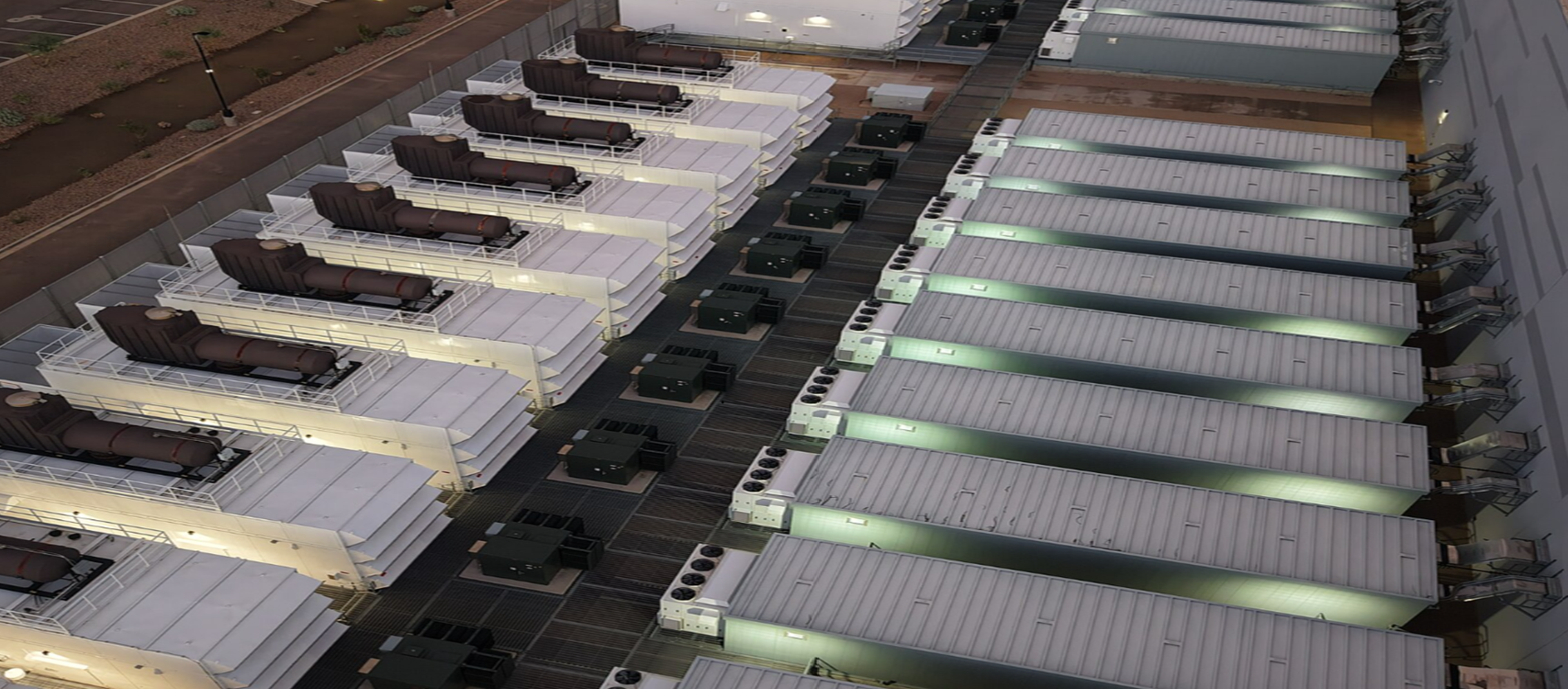
Backup generators and electric power hardware at a data center in the western U.S. (courtesy of Wikimedia)
Don’t be afraid to show up and ask a question, even if someone thinks it’s silly. Show up, get involved… Go to a city council meeting, half the time there’s no one there… So it makes a big difference when it’s like, okay, we have 700 people who just showed up!
— Erin Brockovich, an interview with The New Lede
Overview
In the first two posts in this series, we looked at the extraordinary scale of the AI data-center buildout now underway — and at some of the consequences that could follow if that expansion moves ahead without adequate planning, without urgently needed environmental and public health safeguards, and without informed debate and public oversight.
Those consequences include much higher electricity demand, more pressure to keep fossil-fuel power plants operating, growing demands on the electrical grid, potential increases in utility costs, and very localized impacts from backup generators, construction, traffic, noise, and other industrial infrastructure.
In particular, the leaders at Climate Reality Bay Area want to spotlight how a rapid increase in energy demand is nearly certain to significantly increase greenhouse gas emissions — especially if the race for AI compute dominance means compromising on clean energy transition and targets.
In fact, California already has more than 200 active data centers. The California Energy Commission estimates that data centers accounted for about 1,000 megawatts, or roughly 2% of California ISO peak electricity demand, in early 2026 — and projects that figure could grow to around 4,500 megawatts, or 9% of peak demand, by 2040, that’s a massive electricity-demand increase over just 15 years.
The CRBA Writers Team pledges to share climate truths you can trust — not noise.
With information grounded in facts, science, reputable media, and cited openly, our work cuts through disinformation to empower our community toward climate action and justice.
Even closer to home, Silicon Valley’s tech titans are fueling much of the AI and data-center frenzy, and San Jose alone already has about 20 active data-center sites, with roughly 13 more projects either under review or recently approved.
In San Francisco, approximately a dozen or more data-center sites or campuses are already operating, concentrated largely along the Embarcadero and in Bayview–Hunters Point, while at least one major expansion and several additional proposals are moving through planning or early development. The largest is the NOVVA facility in Bayview, which began operating an initial 9-megawatt phase this year and is planned to grow to 36 megawatts.
Across the East Bay and Solano County, the existing footprint is smaller but the development pipeline is rapidly growing: the three counties have at least several existing data-center sites and roughly five to 10 identified projects that are proposed, approved, or under construction.
These projects include a 67-megawatt facility under construction in Hayward, an approved first phase of a 76-acre data-center campus in Pittsburg, a proposed Oakland facility, and prospective projects in Vallejo and Fairfield.
As developers and big tech rush ahead, ordinary residents and some local representatives are leading efforts to impose moratoriums or secure safeguards to regulate the process.
Those leading mobilizations and policy actions sometimes have diverse goals, ranging from stopping AI and AI data centers altogether, to ensuring there are measures and timelines in place that will ensure transparency, allow for robust community input, to examine pathways for the greatest possible environmental responsibility and sustainability, and to examine if and how such developments will benefit local communities before permits are handed out.
For these city council members, I don’t know where their courage went, but I think what’s happening is these huge tech giants have all the money in the world, and that [these members] are having a really hard time turning away from that money.
— Erin Brockovich, an interview with The New Lede
Who’s Leading AI Data Center Policymaking and Resistance Across the Greater SF Bay Region?
Statewide, Governor Gavin Newsom recently signed seven data-center bills addressing electricity costs, water use, energy and efficiency reporting, environmental review, and local planning oversight.
Bay Area legislators are behind several of the bills, including Assemblymember Rebecca Bauer-Kahan (D-Orinda), whose AB 1577 requires public reporting on data-center energy use and efficiency, Assemblymember Diane Papan (D-San Mateo), author of AB 2469 and AB 2619 to address water-use disclosure and water planning.
Senator Jerry McNerney (D-Pleasanton), coauthored SB 886 and author of SB 1168 in order to prevent the rising energy demands that result from large data-center loads from being shifted to ordinary ratepayers.
None of these state bills put a halt on construction, but they do try to set up mechanisms and regulatory guidelines that will promote greater transparency, utility accountability, and local permitting input, review, and oversight.
San Francisco Supervisor Shamann Walton, joined by Supervisors Connie Chan, Jackie Fielder, and Chyanne Chen, introduced a 45-day interim moratorium on new data-center approvals so the city can assess impacts and develop permanent rules.
In Oakland, Councilmember Carroll Fife advanced a proposed 45-day emergency moratorium to stop new approvals while the city evaluates water, energy, and environmental impacts.
At the epicenter of local AI data center growth pressures is the city of San Jose. San Jose Mayor Matt Mahan believes that data center development can create positive revenue streams — in the millions — for city services and programs, but also emphasized the need for accountability and transparency:
“Revenue cannot be a permission slip to ignore quality of life or harm the environment. A project that creates economic value while shifting environmental or other costs to nearby families is not a good deal.”
In tandem with Mayor Matt Mahan, San Jose Councilmembers Peter Ortiz, David Cohen, and Domingo Candelas directed staff to develop citywide regulatory standards covering power demand, water and cooling, diesel backup generators, greenhouse-gas emissions, noise, water quality, public notice, and community engagement.
Ortiz has also pressed for limits on confidentiality agreements that can keep key project information from the public, such as the imposition of NDAs — non-disclosure agreements.
These kinds of agreements have been making headlines of late and are provoking anger from impacted residents. By sealing the lips of of city officials and limiting community oversight and input, NDAs put the interests of for-profit developers before the interests of constituents:
“Many times the negotiations between data center developers and officials from the municipality or county are conducted behind closed doors, protected by non-disclosure agreements (NDAs). As a result, community members have significantly fewer opportunities to influence the terms by which the data center should abide by as a fixture in the community.” (Federation of American Scientists, 11 August, 2026)
The public response to recent data center proposals has made it clear that we need to approach data center development differently in San Jose. We must establish strong environmental protections and quality-of-life standards that safeguard our neighborhoods.
— San Jose District 8 Councilmember Domingo Candelas
Community organizations across the SF Bay Region are also mobilizing to stop or slow AI data center development.
Some organizations already have community roots; others have been spawned primarily to organize residents around the data center issue. Here are just a few examples:
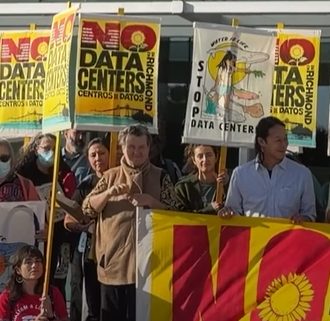
Communities for a Better Environment, joined by the Asian Pacific Environmental Network, Reclaim Our Power, ACCE Action, Food & Water Watch, and the Center for Biological Diversity, helped mobilize Richmond residents behind a 45-day moratorium on new data centers.
In the South Bay, Mothers Out Front Silicon Valley and the I Love San Jose coalition have called for stronger health, water, energy, and public-disclosure safeguards. Together, these campaigns make a common demand: AI infrastructure should not move forward faster than communities can understand, scrutinize, and shape its consequences.
AI infrastructure should not move forward faster than communities can understand, scrutinize, and shape its consequences.
What more can ordinary residents actually do to impact or stop data center developments and/or protect their communities and the larger public interest?
Why Communities Do Have Leverage
Implementing a moratorium will give us time as a City to study the environmental and economic impacts of AI data centers, modernize our laws to keep pace with advancements in technology, and establish guardrails to help keep our communities safe.
— Oakland District 4 Councilmember Janani Ramachandran (The Daily Californian, 28 September, 2026)
One of the most important things to understand about data-center development is that many of the decisions that shape it happen locally.
Getting a large AI data center built requires zoning decisions, planning approvals, environmental review, electricity and water connections, development agreements, infrastructure upgrades, and public hearings involving city councils, county supervisors, planning commissions, utilities, and other public agencies.
These processes create opportunities for public involvement — particularly before a project has moved too far through the approval process.
Here in the greater SF Bay region, Richmond and Oakley offer useful Bay Area examples for those asking themselves if local organizing and “showing up” really can make a difference.
In both cities data center development became a significant enough local issue that moratoriums ensued.
These pauses pave the way for hearings, public outreach and information sharing, and for informed deliberations about what kinds of policies, community safeguards, and community sentiments and perspectives need consideration. This can include discussions about securing community benefit agreements from developers if a project does go forward.
In the wake of the moratorium imposed in Oakley, citizens in Richmond also mobilized and helped secure a citywide data center moratorium there as well.
A Closer Look: The Case of Richmond’s AI Data Center Moratorium
In Richmond, environmental-justice groups and residents organized and acted pre-emptively. They didn’t want Richmond — already burdened by Chevron refinery pollution — to become exploited again, this time by big tech instead of big oil.
Communities for a Better Environment (CBE) led the No Data Centers in Richmond campaign alongside other partner organizations, putting at the forefront concerns around cumulative industrial pollution, electricity costs, water use, and public health.
The campaign made the policy fight highly visible and local. For example, organizers held a press conference with Councilmembers Claudia Jimenez and Sue Wilson, followed by a community dinner and evening rally, before speaking out at the September 15 City Council meeting. Earlier in the month they prepared to make an impact at the upcoming City Council Meeting by inviting community members to another event to create signs, posters, and patches for the No Data Centers in Richmond campaign and to get help preparing and practicing their public comments before the hearing.
Other mobilization tactics included distributing yard signs, putting up campaign posters in busy parts of the city, and door-to-door canvassing in city neighborhoods.
Richmond’s City Council then approved a 45-day emergency moratorium on new data-center development, giving the city time to study impacts and consider longer-term rules or a ban.
California law allows cities to adopt temporary urgency measures while they study potential threats to public health, safety and welfare and consider longer-term regulations. Without local safeguards, large data centers could place significant new demands on Richmond’s electricity and water systems, contribute additional pollution, and expose residents to higher infrastructure and utility costs.
— Communities for a Better Environment, 15 Sept., 2026
While not every community will use the same tactics or get their leaders to follow the exact same path, Richmond’s example shows that getting mad, getting organized, and getting the word out can really make a difference — taking your local community from feeling powerless to having a powerful voice in shaping decision-making and outcomes when it comes to putting the brakes on unchecked AI data center proliferation.
Key Ways Communities Can Influence Data Center Decisions

In most cases, the best strategy will be to get ahead of the wave — to mobilize folks, if possible, before city or county officials start signing back office NDAs or reviewing, finalizing, and authorizing permits and development agreements.
A few practical organizing strategies stand out:
Track projects early. Sign up for planning notices, monitor city council and planning commission agendas, and watch for data centers, major industrial projects, substations, backup generation, and large new electricity loads.
Ask for the basic facts. Press for clear information on electricity demand, power sources, backup generators, emissions, water use, noise, traffic, infrastructure needs, and who will pay for upgrades.
Use public comment opportunities. Submit written comments, speak at hearings, and ask agencies to address specific concerns related to climate impacts, utility costs, public health, environmental justice, and neighborhood quality of life.
Push for transparency before approval. If important information is missing, ask officials to delay decisions until communities have enough information to evaluate the project responsibly.
Seek enforceable safeguards. If a project moves forward, advocate for binding conditions addressing clean energy, generator use, air and noise monitoring, public reporting, infrastructure costs, local hiring, and community benefits.
Build coalitions. Connect with neighborhood groups, environmental organizations, environmental-justice advocates, ratepayer groups, researchers, and local journalists. Shared expertise and coordinated advocacy can make local participation much more effective.
Think regionally. Data-center projects may be approved locally, but their effects on the grid, air quality, water systems, and electricity costs can extend far beyond city limits. Regional coordination can strengthen local efforts.
Reader Resource Guide
The following organizations and tools can help Bay Area residents track proposed AI data centers, understand their local impacts, and join campaigns for stronger public oversight, environmental safeguards, and community decision-making.
Track projects and get informed
Brockovich AI Data Center Reporting
Erin Brockovich’s data-center reporting hub offers plain-language information about the environmental, health, water, energy, and community concerns associated with the rapid expansion of AI infrastructure.More Than Just Parks: Data Center Tracker
A free, public-record–based map for locating proposed, under-construction, operating, and stopped data-center projects. It is an advocacy-oriented tool, but its project pages can be a useful starting point for finding permits, developers, local records, and nearby environmental concerns.San Francisco Chronicle: Map of California Data Centers
This interactive statewide map — some content may require a subscription — offers a useful visual overview of California’s operating and planned data centers, including several major Bay Area projects.
Join Bay Area organizing
Communities for a Better Environment (CBE)
A leading environmental-justice organization in the East Bay and organizer of the No Data Centers in Richmond campaign, which helped win Richmond’s 2026 temporary moratorium. CBE connects data-center growth to refinery-era pollution burdens, electricity costs, water demand, and community power.Asian Pacific Environmental Network (APEN)
APEN brings Asian American, immigrant, and working-class community organizing to the fight over land use, public health, and economic justice. It is part of the Richmond coalition urging strong protections against harmful data-center development.Reclaim Our Power
A statewide energy-democracy network active in the Richmond coalition. Its work is especially relevant for readers concerned that new AI data centers could drive fossil-fuel generation, strain the grid, and shift infrastructure costs onto ordinary utility customers.ACCE Action
The Alliance of Californians for Community Empowerment Action works on affordability, corporate accountability, and grassroots civic participation. It has joined East Bay organizing around data centers and offers a pathway for residents who want to engage in public hearings, local ordinances, and community-benefit campaigns.Center for Biological Diversity
The Center has pushed for regional regulation of data-center diesel backup generators, including stronger safeguards from the Bay Area Air Quality Management District. Its work is useful for following the air-pollution, climate, noise, and public-health dimensions of data-center permitting.Mothers Out Front Silicon Valley
This South Bay climate-justice group has called for transparent, health-protective standards for San José data centers and meaningful resident participation before projects move forward. It is a particularly relevant resource for families and neighborhood advocates concerned about water, energy, diesel pollution, and public disclosure.I Love San Jose coalition
This grassroots San José coalition has called for rigorous public review, disclosure of electricity and water demand, and independent assessment of proposed facilities’ health and environmental impacts. Follow local San José public meetings and advocacy networks for opportunities to participate in its work.
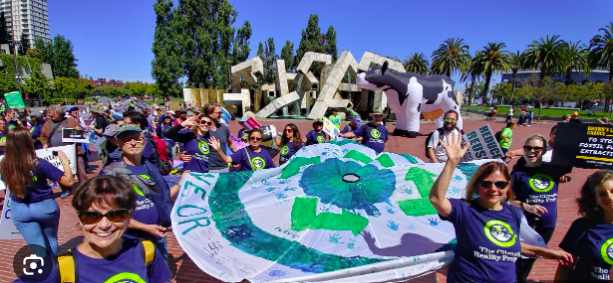
Ready to get (more) involved with CRBA?
Whether you want to join our campaign for moratoriums on AI data center development, get involved with a team that matches your interests, or start a new team… Climate Reality Bay Area offers residents across the greater SF Bay Delta Region many ways to connect and amplify their voices.
Email us at: climaterealitybayarea@gmail.com to get started!
About the author:
Keith Nickolaus, PhD is a grant professional, digital content writer, and former K-12 educator based in Berkeley. He has been a CRBA member since 2024 and a member of the Climate Reality Project Leadership Corps since 2026.
Interested in writing for CRBA? Email us at crbawriters@gmail.com to learn more!