Local Industry Leaders As Climate Allies? What I Learned Attending CRBA’s Screening of Beyond Zero
By Keith Nickolaus, PhD, CRBA Writers Team
I recently joined a gathering of about thirty climate activists for a screening of Beyond Zero at the Interface showroom in San Francisco, and I’ve been thinking about it ever since. The film recounts how the CEO of Interface, a global carpet company, was inspired to put the company on a path to sustainable practices starting back in the 1990s. Seeing that story in the place where some of those innovations now live made the experience more grounding.
Discovering how Interface’s corporate journey wasn’t driven by existing technologies or by mandates or corporate governance fads — but above all by a corporate leader’s uncompromising commitment to environmental accountability — a where there’s a will there’s a way approach — made me see that the biggest obstacle to solving the climate crisis may be the narratives we’ve created for ourselves.
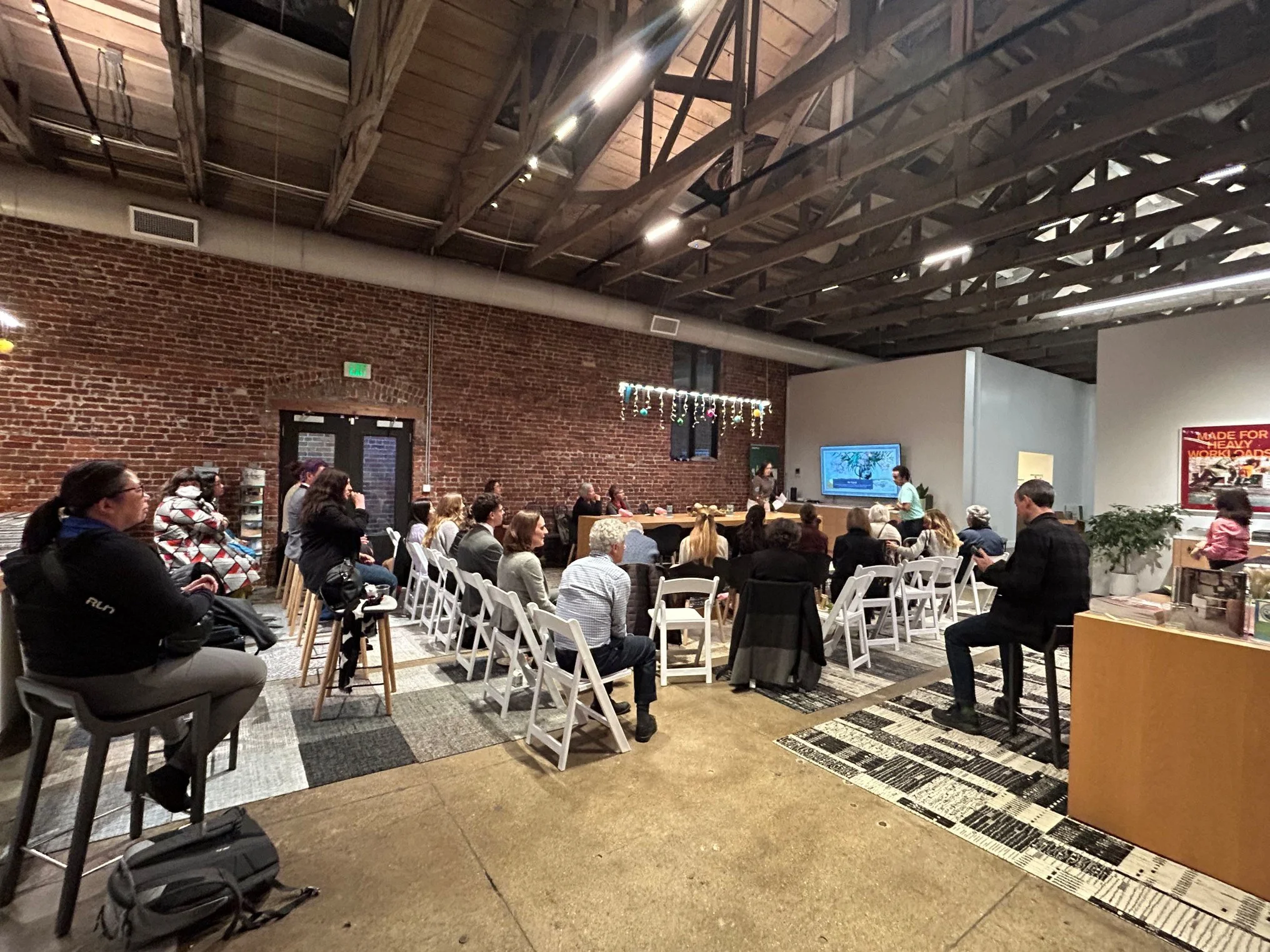
Beyond Zero Movie Night at the Interface SF Showroom, on November 20, 2025, sponsored by Climate Reality Bay Area and IIDA Northern California
Overview
The film Beyond Zero tells the story of how Interface — one of the world’s largest commercial carpet companies — ended up on an unexpected path toward deep sustainability. It begins with CEO Ray Anderson’s environmental awakening, a moment that pushed him to question the entire foundation of a business built on petroleum and filling landfills. What follows is the story of a corporation trying to transform itself from the inside out.
Anderson launches what he calls Mission Zero, a commitment to eliminate waste, pollution, and the company’s overall environmental footprint by 2020.
For a flooring manufacturer dependent on fossil fuels, this meant reimagining everything about how they operated. His goal, as he explained it, was to eventually run the company in a way that only relied on resources the Earth could naturally and quickly replenish.
Watching the film, what struck me was how earnest and challenging this journey really was. Interface didn’t pretend it would be easy; they stumbled, debated, experimented, and kept going anyway.
The innovations that eventually emerged — recycled materials, low-impact manufacturing, even carpet tiles designed to store carbon — felt like the natural result of a company that gets a high from being on the cutting edge while doing the unthinkable in the business world: holding itself to a very high level of accountability for the environment and the external costs of its business model.
“We Need Winners”
When I walked into the Interface showroom, I honestly wasn’t sure what to expect. I’ve seen sustainability messaging on so many corporate walls that I’ve become a little numb to it. And while Interface may have been ahead of its time, I certainly was skeptical about any narrative making corporations into champions for protecting the environment, not to mention my lack of interest in seeing another version of the “great man” theory of history and progress.
I also anticipated the film was about changes the company made years ago, making it mostly a historical curiosity, with limited relevance for today’s activists.
As you can see, the narratives I (we?) live in as climate activists are real. What the film left me with, however, was a different narrative, not one that pits climate activism against big corporations but which demolishes the artificial wall between corporate growth vs. enlightened governance and aggressive environmental stewardship.
We can all point to many corporations where greed itself reigns supreme, but Interface’s journey is one where competitive agility and environmental commitments — seemingly self-evident contradictions for a global commercial carpeting manufacturer — turned out to be on the same side of the corporate governance coin.
Curiously, the spark for all this seemed to lie, in Interface’s case, with the unexplained epiphany of the company’s CEO — not something highly replicable or likely to bring other corporate leaders on board.
In fact, when Interface CEO Ray Anderson initially shared his vision with his environmental advisors “dream team,” most told him that it wasn’t reducing the impact of carpet manufacturing that mattered most, it was demonstrating to the business world that pursuing sustainable practices goes hand in hand with competitive advantages: helping corporations see that environmental commitments could turn large companies into business winners — this is the narrative that would be the bigger game changer.
Business is the only mechanism on the planet today powerful enough to produce the changes necessary to reverse global environmental and social degradation.
— Paul Hawken, The Ecology of Commerce
This made me wonder, as climate activists, is it effective to “preach” to corporate leaders about being more responsible, or is it more practical to get better at talking the language of business and commerce, by putting a spotlight on how sustainability commitments serve to accelerate competitive innovation?
Do we deepen the narratives that divide environmental action from business growth? Or do we shift — and leverage the ethos and language of innovation to engage and inspire corporate commitments to sustainability (even while we continue to openly and critically examine a range of economic models and visions)?
Seeing Environmentalism Through a Corporate Lens
At the root of it, Interface’s journey seemed to be driven by a largely idealistic vision and motive. But a closer look offers something more nuanced.
In the 1990s Interface was boasting about how “indestructible” its carpet tiles were. But when the CEO finds out they may lose a big potential client on the advice of the client’s environmental consultant, Anderson is upset to realize that his sales team has no inkling of how to respond and win the client. He then learns an early lesson in something akin at the time to doughnut economics reading Hawken’s book about the empirical limits that earth’s resources place on manufacturing and commerce. In essence, it’s Ray’s “stay ahead of the pack” business instincts along with a very human vision that lead him to realize that sustainability is both a stewardship mission and a crucial business interest.
And, as the journey unfolds, it’s evident that efforts to change the company and bring others into the fold started with imparting a vision first and foremost — what systems thinkers refer to as an adaptive challenge. Interestingly, Ray Anderson didn’t achieve this using mysticism or pure charisma, he fused vision with pragmatism by showing in very tangible examples how sustainable practices, environmental benefits, and lean and competitive business practices all went hand in hand — with a sizable impact to the bottom line.
The next phase of the innovation journey focuses on technical challenges… Each step seems to start in the same way — with a quixotic commitment to doing the impossible…
The next phase of the innovation journey focuses on technical challenges — the practical, often innovative technological solutions that need to be identified and implemented. Each step of technical innovation seems to start in the same way — with a quixotic commitment to doing the impossible and no one having a clue how to do it!
However, once it becomes clearer, with each successive win, that the right mix of idealism, vision, commitment, active learning, and change agency can make the seemingly impossible possible, then taking on the impossible is no longer belittled as mad or quixotic. Instead, committing to doing the right thing evolves into a best practice — a powerful engine of organization-wide engagement and innovation unlocking new drivers of commercial success at each turn.
This matters because it isn’t like were watching another version of the 2000 film Erin Brockovich.
Beyond Zero presents us climate activists with a different narrative.
Interface’s journey doesn’t unfold as a pitched battle between environmentalists on one side and corporate leaders on the other, but almost entirely within the corporate world — the sphere of C-suite meetings and annual company conventions — revealing sustainability commitments and innovations through the lens of business people, organizational systems, and organizational psychology — with little reference to regulatory frameworks or mere “greenwashing.”
It isn’t like were watching another version of the 2000 film Erin Brockovich. Beyond Zero presents us climate activists with a different narrative.
The Local Angle — Building a Bridge Between Opposing Mindsets
There’s a lot to climate action that falls outside of the corporate sphere of course, and Interface’s journey does not give credence to a pure free-market-driven “invisible hand” version of corporate environmental leadership. However, the events documented in the film do give us local climate activists with a bigger vision and more expansive vocabulary for engaging business leaders in a common cause, one that’s both deeply human and economic.
Because the Bay Area Chapter of Climate Reality lives at the doorstep of a thriving hub of business interests and technology innovation, it makes sense, I think, for local climate activists to reflect on effective ways to fuse environmental interests with corporate agendas, as opposed to just thinking about regulatory mandates, for example. What do you think?
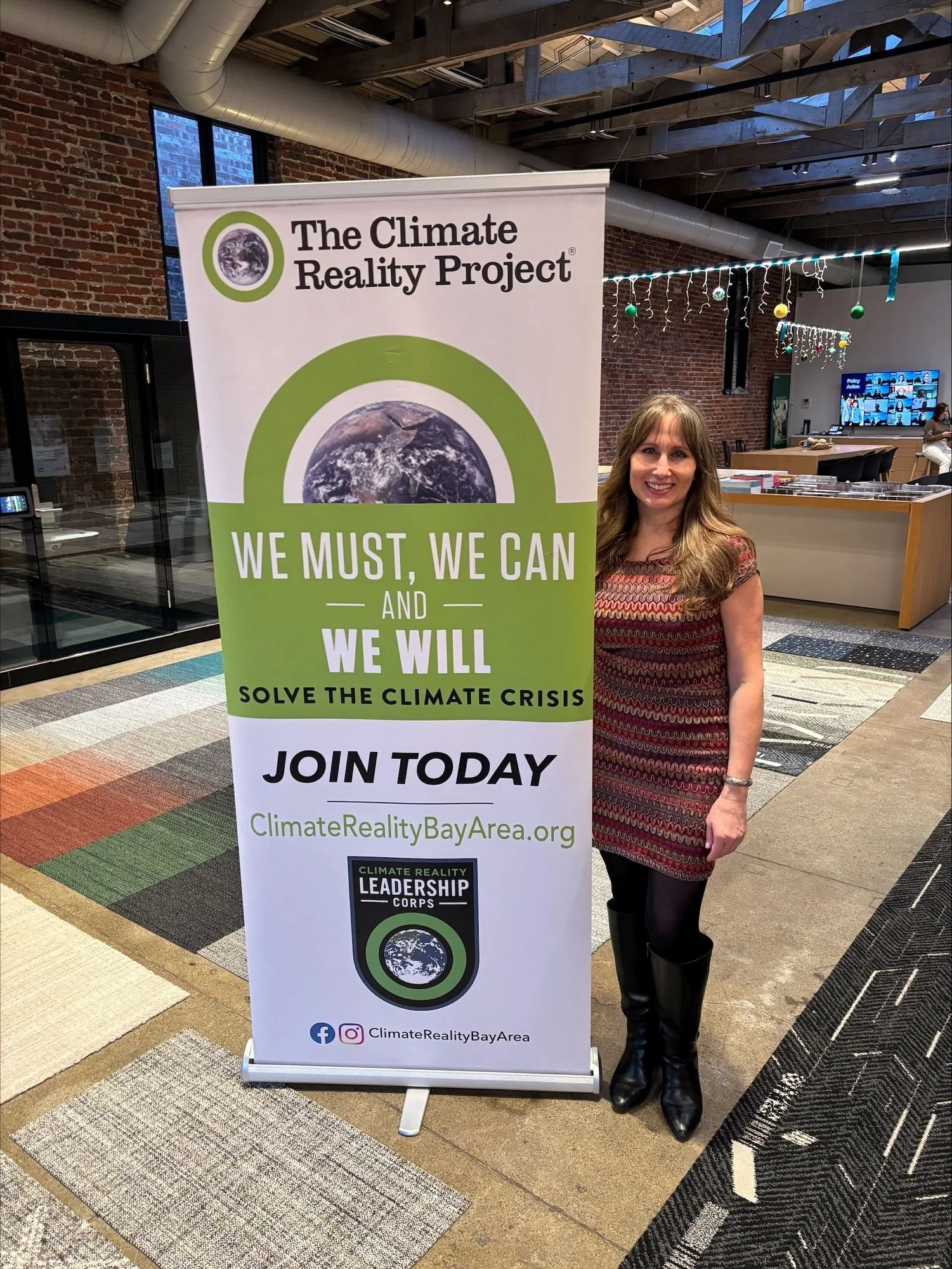
The film Beyond Zero and the screening CRBA co-sponsored not only put community-based climate activists in the same physical space as global leaders in manufacturing, but the film used an inspirational narrative to build a deeper bridge between us, between the distinct silos and narratives that climate advocates and corporate leaders tend to inhabit.
The film was also a stark reminder of what it could mean if instead of only seeing corporate interests exacerbating environmental harm, we think more about what corporate interests have to put to work for the environment — such as an incredible entrepreneurial drive and vast global reach.
For Interface, at least, the vision proved contagious and it energized amazing innovations. The film begs us to ask how climate activists can spark commitments like these among today’s Bay Area “titans of industry.”
What You Can Do
There are many opportunities to engage more as a member of CRBA.
If you want to turn your commitment to a better future for both humanity and commerce into action, check out the film Beyond Zero if you haven’t seen it yet.
Whether it’s joining a policy action squad, helping out with the engagement team, or jumping in with the communications team, there’s honestly a place for anyone who wants to contribute, and all levels of engagement are welcome as we know finding the time to volunteer can be challenging.
If you’re not sure where to plug in, the best place to start is our overview of teams and opportunities:
https://www.climaterealitybayarea.org/learn-more
Closing Reflection
On the way home that night, I kept thinking about how messy Interface’s story actually was — full of failures, experiments, and skepticism from employees and investors. And honestly, that messiness made me feel strangely motivated. We don’t need perfect conditions or perfect consensus to make progress. We don’t need to believe we can or can’t solve the climate crisis, and we are likely to achieve the most by simply thinking bigger and remembering that others have already shown us, where there’s a will there really is a way.
Author Bio
Keith Nickolaus is a communications professional and former educator based in Berkeley. As leader of the CRBA Writers Team, he works to amplify community voices and is passionate about informing and inspiring climate action across the Bay Area.
Background Sources
Walker College of Business panel discussion on Beyond Zero (April 23, 2021)
The CEO that Realised the Immense Environmental Damage he Caused | Beyond Zero
#Bay Area climate action - #commercial decarbonization - #climate solutions - #CRBA events
Related Posts
How Community-Driven Action Is Decarbonizing Bay Area Businesses—One Upgrade at a Time